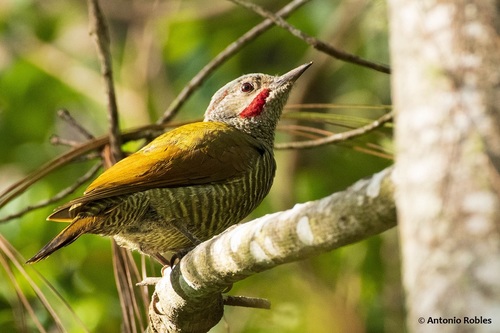
Gray-crowned Woodpecker
Colaptes auricularis
An elusive treasure of the Mexican Pacific slope, the Gray-crowned Woodpecker is a master of the canopy. With its golden-yellow nape and distinctive gray cap, it is a must-see for any bird enthusiast visiting the western Sierra Madres.
Quick Identification
Size
Length: 18-21 cm (7-8.3 inches); Weight: 50-65 g (1.8-2.3 oz)
Colors
Gray forehead and crown; golden-yellow nape; olive-brown barred back; buffy underparts with black bars. Males have a red moustachial stripe, females have black.
Key Features
- Solid gray crown and forehead
- Bright golden-yellow patch on the back of the neck
- Heavy black barring on pale underparts
- White rump patch visible in flight
When You’ll See Them
Geographic range
Where Does the Gray-crowned Woodpecker Live?
The Gray-crowned Woodpecker is a proud endemic of western Mexico. Its native range is concentrated along the Pacific slope, stretching from southern Sinaloa and Durango through the Sierra Madre Occidental down to Oaxaca. It is a resident species, meaning it stays within this specific Mexican corridor year-round without migrating.
Basemap © OpenStreetMap contributors
Behavior
The Gray-crowned Woodpecker is a specialized climber that spends much of its day hitching up tree trunks in search of insects. Unlike some of its more social relatives, this species is typically found alone or in pairs. It is relatively shy and tends to stay within the mid-to-upper canopy, making it a rewarding but challenging subject for wildlife observers.
They are known for their methodical foraging style, using their stiff tail feathers for support as they tap on bark to locate hollow spots. While they are territorial, they are not overly aggressive toward other species. Their vocalizations include a series of sharp 'wick' calls and a rhythmic drumming used to signal territory or attract mates during the breeding season.
EverydayEarth exclusive
Camera Tips
To capture high-quality footage of a Gray-crowned Woodpecker, placement is everything. These birds are arboreal specialists, so mounting your camera on the ground will rarely yield results. Instead, strap your camera to a vertical trunk of a mature tree, preferably one with some visible bark decay or lichen, at a height of 7 to 10 feet. Angle the lens slightly upward to catch them as they hitch their way toward the canopy.
Because they are endemic to specific Mexican forest types, look for 'sign' like fresh wood chips at the base of trees or small, round drill holes. If you have a backyard near their habitat, you can attract them with a suet feeder. Use a high-protein suet containing dried insects or mealworms, as this mirrors their natural diet better than seed-based cakes. Place the feeder directly against a tree trunk to make them feel secure while feeding.
Light is a major factor in identifying this species on camera. Try to position your camera facing north or south to avoid the direct glare of the Mexican sun, which can wash out the subtle gray of their crown. Early morning is the best time for activity; set your camera's trigger interval to the shortest possible setting to ensure you catch the quick, jerky movements of their head as they scan for predators or prey.
Similar Species
Species that look similar or are commonly confused with Gray-crowned Woodpecker.
Frequently Asked Questions
Record Gray-crowned Woodpecker at your habitat
Connect a camera to start building your own species record — AI identifies every visitor automatically.