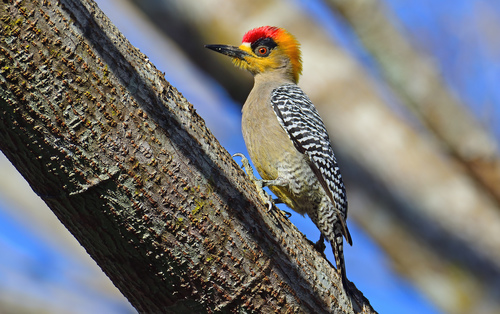
Golden-cheeked Woodpecker
Melanerpes chrysogenys
A radiant endemic of Western Mexico, the Golden-cheeked Woodpecker brings a flash of gold and rhythm to the Pacific coast. With its zebra-striped back and vibrant facial patches, it is one of the most striking and sociable woodpeckers you can discover in a tropical garden.
Quick Identification
Size
Length: 17.5–19.5 cm (6.9–7.7 in); Weight: 37–60 g (1.3–2.1 oz)
Colors
Golden-yellow cheeks and forehead; black-and-white barred back; gray breast. Males have a bright red crown patch; females have a gray crown.
Key Features
- Distinctive golden-yellow patches on the cheeks and nape
- Finely barred black and white 'ladder' pattern on the back
- Red crown on males, gray on females
- Yellowish wash on the lower belly
When You’ll See Them
Geographic range
Where Does the Golden-cheeked Woodpecker Live?
The Golden-cheeked Woodpecker is a North American endemic, found exclusively along the Pacific slope of Mexico. Its core range extends from southeastern Sonora south through Sinaloa, Jalisco, and Colima, reaching into eastern Oaxaca. It is a lowland specialist that stays within this coastal corridor, rarely wandering far inland or into high mountain ranges.
Basemap © OpenStreetMap contributors
Behavior
The Golden-cheeked Woodpecker is an energetic and vocal resident of Mexico's coastal forests. Typically seen in pairs or small family groups, they are highly active foragers that move with a characteristic 'hitch' up tree trunks. They are not particularly shy and have adapted well to human presence, often visiting suburban gardens and plantations where food is abundant.
These birds communicate through a series of loud, rattling calls and rhythmic drumming on resonant branches. Like many members of the Melanerpes genus, they are socially interactive and will vigorously defend their nesting cavities from competitors. They are year-round residents, meaning they do not migrate and can be observed maintaining their territories throughout every season.
EverydayEarth exclusive
Camera Tips
To capture high-quality footage of the Golden-cheeked Woodpecker, mount your AI-powered camera 5 to 7 feet high on a vertical tree trunk. They prefer trees with rougher bark, such as mesquite or acacia, which provide better grip for their zygodactyl feet. Position the camera so it faces a known foraging spot or a cavity entrance. Because these birds move quickly and sporadically, use a high-speed trigger setting to catch them mid-climb.
This species is particularly attracted to fruit, making them excellent subjects for backyard camera setups. Placing a platform feeder stocked with halved oranges, bananas, or fresh figs within the camera's view is a foolproof way to get clear, close-up shots. They are also known to visit nectar feeders designed for orioles or hummingbirds, so consider placing your camera near these stations during the dry season when natural food sources might be scarcer.
Lighting is crucial for bringing out the 'golden' in their cheeks. Try to orient your camera facing north or south to avoid direct glare from the tropical sun, which can wash out their pale gray underparts. Early morning light provides the best warmth to highlight their yellow plumage. If you are monitoring a nesting site, ensure the camera is far enough away to avoid disturbing the parents; a 10-15 foot distance with a slight zoom or high-resolution crop is ideal for capturing their natural nesting behaviors.
Similar Species
Species that look similar or are commonly confused with Golden-cheeked Woodpecker.
Frequently Asked Questions
Record Golden-cheeked Woodpecker at your habitat
Connect a camera to start building your own species record — AI identifies every visitor automatically.