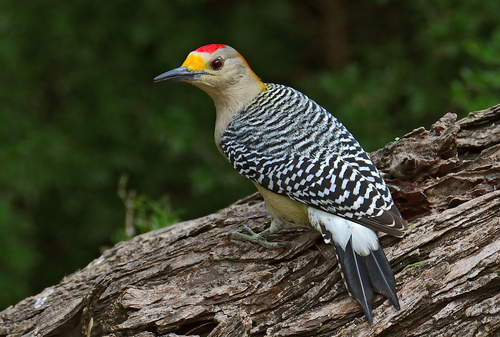
Golden-fronted Woodpecker
Melanerpes aurifrons
With its striking golden nape and bold zebra-striped back, the Golden-fronted Woodpecker is a charismatic staple of the Southern landscape. A vocal and energetic visitor to backyard feeders, this bird brings a splash of desert color and lively activity to any garden.
Quick Identification
Size
Length: 8.7–10.2 in (22–26 cm); Wingspan: 16.5–17.3 in (42–44 cm); Weight: 2.3–3.5 oz (65–100 g)
Colors
Pale gray underparts, black and white 'zebra-barred' back, golden-yellow nape and forehead tufts. Males feature a bright red crown patch; females do not.
Key Features
- Golden-yellow patches on the nape and above the bill
- Horizontal black and white barring on the back and wings
- Red crown patch on males, absent on females
- Stiff tail feathers used for bracing against tree trunks
When You’ll See Them
Geographic range
Where Does the Golden-fronted Woodpecker Live?
This resilient woodpecker is native to North and Central America, with its heartland stretching through the brushlands of Texas and southern Oklahoma. From the American Southwest, its range extends deep through Mexico's central and eastern highlands, reaching southward into the tropical dry forests of Guatemala, Honduras, and Nicaragua. As a non-migratory resident, it remains in these sun-drenched landscapes year-round, often thriving in areas where mesquite and oak trees provide ample nesting sites and foraging opportunities.
Basemap © OpenStreetMap contributors
Behavior
The Golden-fronted Woodpecker is a highly vocal and energetic bird, known for its loud 'churr-churr' calls and rhythmic drumming on resonant surfaces like hollow logs or even metal chimneys. They are territorial and can be quite aggressive toward other birds at feeders, often dominating smaller species to claim access to suet or fruit. While they spend much of their time hitching up tree trunks in search of insects, they are also agile enough to flycatch in mid-air or forage on the ground for fallen nuts and berries.
Socially, these woodpeckers are typically seen in pairs or as solitary individuals. They are cavity nesters, often excavating new holes each year in mesquite, oak, or pecan trees, which later serve as vital homes for other backyard wildlife like bluebirds and screech-owls. In suburban environments, they adapt well to human presence, frequently visiting backyards that offer mature trees and reliable water sources.
EverydayEarth exclusive
Camera Tips
To capture high-quality images of the Golden-fronted Woodpecker, place your camera approximately 5 to 6 feet high, facing a vertical structure. They are most comfortable when clinging to bark, so mounting your camera near a suet cage or a 'log feeder' filled with peanut butter will provide the best profile shots. Ensure the camera is positioned to catch the side-view of the bird to highlight the contrast between the zebra-striped back and the golden nape.
Because these birds are rapid movers, use a high-speed trigger setting or a camera with a fast 'shutter' speed to avoid motion blur during their characteristic head-bobbing or pecking. If you are using a trail camera, set it to 'Photo + Video' mode; the videos are particularly rewarding as they capture the bird’s unique vocalizations and rhythmic drumming. For the best lighting, try to position the setup so the sun is behind the camera during the morning hours, which will make the yellow nape and red crown pop.
In hot climates, these woodpeckers are frequent visitors to birdbaths. Setting up a camera near a water feature with a 'low-angle' view can result in spectacular splashing shots. During the breeding season (March–July), look for their nesting cavities in dead trees or telephone poles. Placing a camera at a respectful distance from a nest site can reveal fascinating behaviors, though you should never disturb the nest or place the camera close enough to stress the parents.
Similar Species
Species that look similar or are commonly confused with Golden-fronted Woodpecker.
Red-bellied Woodpecker
Features a red nape instead of golden-yellow, and lacks the yellow tufts at the base of the bill.
Gila Woodpecker
Found further west; has a more uniform tan face and neck without the distinct golden-yellow nape of the Golden-fronted.
Ladder-backed Woodpecker
Significantly smaller with a black-and-white speckled face and a more 'ladder-like' appearance to its back barring.
Frequently Asked Questions
Record Golden-fronted Woodpecker at your habitat
Connect a camera to start building your own species record — AI identifies every visitor automatically.