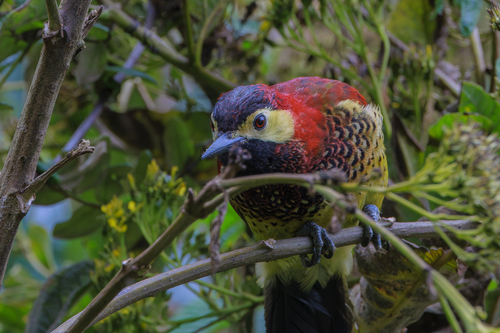
Crimson-mantled Woodpecker
Colaptes rivolii
A jewel of the Andean cloud forests, the Crimson-mantled Woodpecker stands out with its vivid red back and golden-yellow throat. It is one of the most striking high-altitude birds you can discover in South America.
Quick Identification
Size
Length: 22–28 cm (8.7–11 in); Weight: 74–106 g (2.6–3.7 oz)
Colors
Crimson-red back and wings, golden-yellow throat, black crown, and scaly black-and-white underparts. Males have a red malar (mustache) stripe; females have a black one.
Key Features
- Vibrant crimson-red back and mantle
- Bright golden-yellow throat and sides of neck
- Barred black-and-white underparts
- Black crown and nape
When You’ll See Them
Geographic range
Where Does the Crimson-mantled Woodpecker Live?
This stunning woodpecker is a native specialist of the South American Andes. Its range forms a long, narrow corridor through the high-altitude forests of Venezuela, Colombia, Ecuador, Peru, and northern Bolivia. Within this mountainous region, it is exclusively found in the moist, temperate zones of the cloud forest, rarely descending into the tropical lowlands.
Basemap © OpenStreetMap contributors
Behavior
The Crimson-mantled Woodpecker is a social and industrious species of the high Andes. Often seen in pairs or family groups, these birds are much more conspicuous than many of their forest-dwelling relatives. They are known to participate in mixed-species foraging flocks, moving through the canopy alongside tanagers and woodcreepers, though they often maintain their own pace as they spiral up mossy trunks in search of prey.
While they are skilled climbers, this species also displays the characteristic Colaptes trait of ground foraging. They can frequently be found hopping along the forest floor or at the edges of clearings, probing for ants. They communicate with loud, metallic calls and rhythmic drumming that can echo through the mist of the cloud forests they call home.
EverydayEarth exclusive
Camera Tips
To capture the Crimson-mantled Woodpecker on camera, focus on the transition zones where primary cloud forest meets open gardens or clearings. Since these birds are frequent trunk-climbers, mount your camera roughly 5 to 6 feet high on a tree with heavy moss or epiphyte growth. Angle the lens slightly downward to catch them if they decide to forage at the base of the tree or on the ground for ants.
While they may not visit standard seed feeders, you can attract them with suet blocks or by planting native fruiting trees like Schefflera. If you are setting up a trail camera, look for 'snags'—standing dead trees—with visible drill holes or fresh wood chips at the base. These are favorite foraging sites and provide the best opportunity for a high-quality capture during the mid-morning hours when activity peaks.
Because their Andean habitat is often shrouded in mist and high humidity, ensure your camera has a high IP weatherproofing rating. Use a camera with a fast trigger speed (under 0.5 seconds) to catch their quick, jerky movements. If your camera allows for video, set short 10-15 second bursts to capture their unique spiraling climbing behavior and vocalizations.
Similar Species
Species that look similar or are commonly confused with Crimson-mantled Woodpecker.
Frequently Asked Questions
Record Crimson-mantled Woodpecker at your habitat
Connect a camera to start building your own species record — AI identifies every visitor automatically.