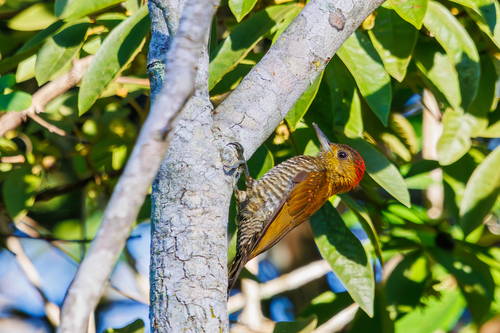
Red-stained Woodpecker
Veniliornis affinis
A vibrant gem of the Amazonian canopy, the Red-stained Woodpecker brings a splash of gold and crimson to the forest. This energetic forager is a favorite for birders throughout tropical South America.
Quick Identification
Size
15–18 cm (5.9–7.1 inches) in length; weighs approximately 31–43 g (1.1–1.5 oz)
Colors
Golden-olive wings and back with distinct reddish-crimson 'stains' or washes. The male has a vibrant red crown, while the female's crown is dark olive. Underparts are finely barred with olive and pale buff.
Key Features
- Golden-olive mantle with red staining
- Finely barred olive and yellowish-white underparts
- Male has a full red crown and nape
- Pale streaking on the face and ear coverts
- Relatively small, straight greyish bill
When You’ll See Them
Geographic range
Where Does the Red-stained Woodpecker Live?
Native to the lush heart of South America, the Red-stained Woodpecker is a permanent resident of the vast Amazon Basin. Its core range spans across northern and central Brazil, reaching westward into the humid lowlands of Peru, Ecuador, and Colombia, and stretching south into northern Bolivia. While it is primarily a bird of the deep tropics, it is also found in the southern reaches of Venezuela, flourishing wherever dense, humid canopy cover remains intact.
Basemap © OpenStreetMap contributors
Behavior
The Red-stained Woodpecker is a highly active and social bird compared to many of its solitary relatives. It is a frequent participant in mixed-species foraging flocks, often traveling through the canopy alongside woodcreepers and tanagers. Unlike larger woodpeckers that pound heavily into trunks, this species uses a combination of light tapping, probing, and gleaning to find its prey, often hanging acrobatically from thin vines or small branches.
While they primarily stay in the middle to upper layers of the humid forest, they are curious birds and will occasionally descend to eye level at forest edges or in clearings. They are not particularly shy of human presence if cover is available nearby, making them excellent subjects for backyard observers located near tropical forest corridors. They communicate with a series of sharp 'wick' notes and a soft, rapid drum that resonates through the humid air.
EverydayEarth exclusive
Camera Tips
To capture the Red-stained Woodpecker on camera, location is everything. These birds prefer the vertical architecture of the forest, so mount your camera 5 to 8 feet high on the trunk of a rough-barked tree. If your backyard or trail is near a forest edge, look for trees draped in vines or epiphytes, as these are their favorite foraging spots. Angling the camera slightly upward can help capture their movements as they spiral up the trunk.
While they are primarily insect-eaters, you can successfully lure them into camera range using high-quality insect-based suet or a specialized 'bark butter' spread directly into the crevices of a tree's bark. Mealworm feeders placed near the trunk can also be effective. Because they are often part of mixed-species flocks, if you see other forest birds arriving, be ready—the Red-stained Woodpecker is likely not far behind.
Set your AI camera to a high shutter speed or 'Sports Mode' if available, as their movements are quick and jerky. They are most active in the early morning light when the forest is waking up. In the dense canopy, light can be low, so ensuring your camera has a good low-light sensor or placing your setup in a spot that receives dappled morning sunlight will significantly improve the color accuracy of their golden-olive feathers and the male's red crown.
Similar Species
Species that look similar or are commonly confused with Red-stained Woodpecker.
Frequently Asked Questions
Record Red-stained Woodpecker at your habitat
Connect a camera to start building your own species record — AI identifies every visitor automatically.