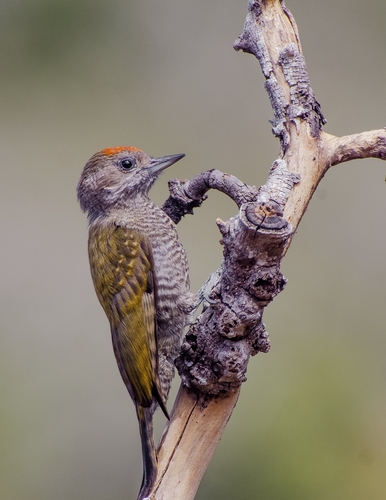
Little Woodpecker
Veniliornis passerinus
The Little Woodpecker is a pint-sized powerhouse of the South American canopy, easily recognized by its olive-green plumage and rhythmic drumming. A frequent visitor to wooded backyards, this adaptable bird brings a splash of crimson and gold to any garden.
Quick Identification
Size
Length: 14–15 cm (5.5–6 in); Weight: 24–37 g (0.8–1.3 oz)
Colors
Olive-green or bronzy back, cream and olive barred underparts; males have a red crown, while females have an olive crown with white spots.
Key Features
- Olive-green back with golden tint
- Zebra-like horizontal barring on the belly
- Small, compact body shape
- Males feature a vibrant red cap from forehead to nape
When You’ll See Them
Geographic range
Where Does the Little Woodpecker Live?
Native to the South American continent, the Little Woodpecker boasts one of the widest distributions of any Neotropical woodpecker. It is found in almost every mainland country including Brazil, Argentina, Colombia, Peru, and Venezuela, though it is notably absent from Chile, Uruguay, and Suriname. This adaptable bird thrives in a variety of lowland environments, from the humid Amazon basin to the drier scrublands of the Chaco.
Basemap © OpenStreetMap contributors
Behavior
The Little Woodpecker is an energetic and social bird, often found moving rapidly through the mid-canopy. Unlike many larger woodpecker species that prefer solitude, these small birds frequently join mixed-species foraging flocks, traveling alongside woodcreepers and tanagers to find food more efficiently. They are highly active and rarely stay in one spot for long, using their stiff tail feathers for balance as they hitch up vertical trunks.
In suburban environments, they are surprisingly bold and can become accustomed to human presence, provided there are enough mature trees for foraging. Their communication involves a series of sharp 'wick' calls and rhythmic drumming on resonant branches, which they use to proclaim territory and attract mates during the breeding season. They are primary cavity nesters, meaning they excavate their own holes in dead wood, which eventually serve as homes for various other backyard species.
EverydayEarth exclusive
Camera Tips
To capture the Little Woodpecker on a backyard camera, placement is everything. These birds rarely spend time on the ground, so avoid low-level setups. Instead, mount your camera 5 to 10 feet high on a sturdy tree trunk, preferably one with rough bark or known insect activity. Aim the lens at a slight downward angle toward a horizontal branch or a fork in the tree where the bird is likely to pause while foraging.
Since they move with quick, jerky motions, use a camera with a fast trigger speed (under 0.3 seconds) and set it to take 3-5 photo bursts. This increases your chances of getting a clear shot of the male's red crown or the female's unique spotting. Good lighting is crucial for bringing out the olive-bronze tones of their feathers, so try to position the camera on a south-facing tree to catch the morning sun without washing out the image.
You can encourage them to visit a specific camera 'stage' by leaving dead branches (snags) in place or by offering suet in a cage-style feeder. While they aren't traditional seed-eaters, they are attracted to the high-energy fats in suet, especially during the cooler months. If you notice wood chips at the base of a tree, you've likely found a nesting site; positioning a camera 10-15 feet away from the cavity entrance can provide incredible footage of their family life.
Similar Species
Species that look similar or are commonly confused with Little Woodpecker.
Checkered Woodpecker
Features black and white plumage rather than olive-green, and is more common in drier, open woodlands.
White-spotted Woodpecker
Larger with more prominent white spotting on the wings and a darker olive base color.
Dot-fronted Woodpecker
Very similar in size but features distinctive white dots on the forehead rather than the crown.
Frequently Asked Questions
Record Little Woodpecker at your habitat
Connect a camera to start building your own species record — AI identifies every visitor automatically.