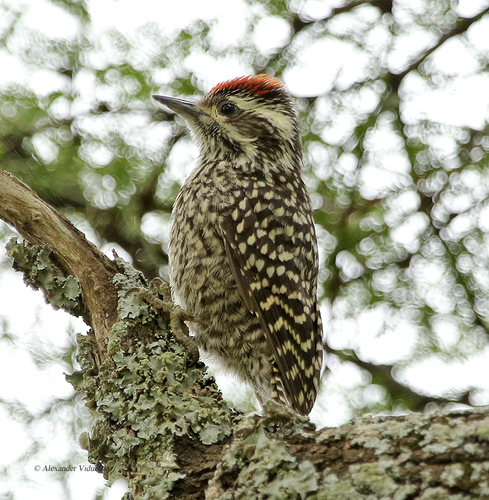
Checkered Woodpecker
Veniliornis mixtus
A small but striking carpenter of the South American woodlands, the Checkered Woodpecker is famous for its bold 'ladder-back' plumage and tireless energy. Whether in a remote forest or a suburban backyard, this adaptable bird is a joy to observe.
Quick Identification
Size
14–15 cm (5.5–6 in) in length; weight approximately 25–35g (0.9–1.2 oz)
Colors
Black and white horizontal 'checkered' barring on the back and wings; white underparts with dark streaking; males have a small red patch on the nape.
Key Features
- Distinct horizontal black and white barring on upperparts
- Small, sharp bill suited for wood-boring
- Males feature a red crown/nape patch
- Heavily streaked or barred underparts
When You’ll See Them
Geographic range
Where Does the Checkered Woodpecker Live?
The Checkered Woodpecker is native to the southern half of South America. Its core range covers the vast landscapes of central and northern Argentina, Uruguay, Paraguay, and the southern interior of Brazil, reaching into the lowlands of Bolivia. It is a common resident across the Southern Cone's agricultural and suburban regions where mature trees are present.
Basemap © OpenStreetMap contributors
Behavior
The Checkered Woodpecker is an active and industrious bird, often seen spiraling up the trunks of trees or out onto thinner branches in search of prey. They are generally solitary or found in pairs, moving with a characteristic undulating flight pattern common to the woodpecker family. Unlike some more reclusive forest species, they are relatively bold and have adapted well to human presence, often foraging in garden trees and city parks.
These birds communicate through a series of sharp 'peek' calls and rhythmic drumming on resonant branches, which serves both as a territorial claim and a way to attract mates. They are highly territorial during the breeding season but otherwise spend their days focused on a systematic search for food, occasionally joining mixed-species flocks to benefit from extra eyes against predators.
EverydayEarth exclusive
Camera Tips
To capture the Checkered Woodpecker on an AI-powered camera, the best strategy is to focus on vertical movement zones. Mount your camera on the trunk of a mature, rough-barked tree at a height of about 4 to 6 feet. Angle the lens slightly upward to catch the bird’s natural upward-spiraling foraging behavior. Because they are small, a camera with a high-resolution sensor and a fast trigger speed is essential to catch them before they hop out of frame.
In a backyard setting, suet is your best friend. These woodpeckers are highly attracted to suet blocks, especially those containing dried mealworms or fruit. Position the camera about 3 to 5 feet away from a suet cage to ensure the bird fills enough of the frame for the AI to identify it clearly. If possible, place the feeder in a spot that receives good morning light, as they are most active shortly after sunrise.
During the spring breeding season (September to November), listen for their drumming. If you find a branch they use for drumming, setting up a camera nearby can capture unique territorial displays. Use a 'burst' or 'multi-shot' setting to counteract their rapid, jerky head movements, which can often cause motion blur in single-frame shots. Ensure the background is somewhat clear to help the camera’s autofocus lock onto the bird’s detailed plumage.
Similar Species
Species that look similar or are commonly confused with Checkered Woodpecker.
Frequently Asked Questions
Record Checkered Woodpecker at your habitat
Connect a camera to start building your own species record — AI identifies every visitor automatically.