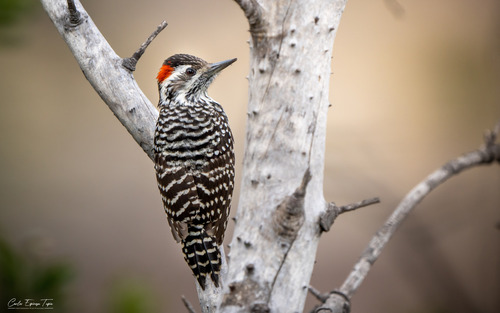
Striped Woodpecker
Veniliornis lignarius
A small but striking specialist of the southern Andes, the Striped Woodpecker is a master of the vertical world, easily identified by its bold 'zebra' plumage and rhythmic drumming.
Quick Identification
Size
Length: 15–16 cm (5.9–6.3 in); Weight: 30–40 g (1.1–1.4 oz)
Colors
Upperparts are boldly barred black and white; underparts are white with dark vertical streaking. Males feature a bright red patch on the nape.
Key Features
- Zebra-like horizontal black and white bars on back
- White breast with distinct vertical dark streaks
- Small, pointed chisel-shaped bill
- Males have a red crown/nape patch while females are entirely black and white
- Stiff tail feathers used for support against tree trunks
When You’ll See Them
Geographic range
Where Does the Striped Woodpecker Live?
Native to the southern cone of South America, the Striped Woodpecker occupies a narrow but long latitudinal range along the Andes. It is found most commonly throughout central and southern Chile and across the border into the Patagonian regions of Argentina. Its range also extends northward into the mountainous regions of southern Bolivia, where it favors semi-arid woodlands and riverine thickets.
Basemap © OpenStreetMap contributors
Behavior
The Striped Woodpecker is an active, industrious bird often observed hitching its way up tree trunks in a characteristic spiral pattern. Unlike some larger, more reclusive woodpecker species, these birds are quite adaptable and frequently venture into backyard orchards and urban parks, especially where mature trees provide ample foraging opportunities. They are generally seen alone or in pairs, maintaining contact with short, sharp 'peek' calls.
During the breeding season, their behavior becomes more conspicuous as they engage in drumming—a rhythmic tapping on resonant wood to declare territory and attract mates. They are relatively tolerant of human presence, making them excellent subjects for backyard observation. Their flight is typically undulating, a common trait among woodpeckers where they alternate quick flaps with short glides.
EverydayEarth exclusive
Camera Tips
To capture the Striped Woodpecker on a backyard camera, placement is everything. These birds rarely spend time on the ground, so avoid low-mounted trail cams. Instead, strap your camera directly to the trunk of a mature tree at a height of 5 to 7 feet (1.5 to 2 meters). Aim the lens slightly upward or across a known foraging branch to catch them in their natural vertical orientation. If you have a bird feeder, mount the camera 3 feet away from a suet cage or a vertical log feeder.
Using a lure is highly effective for this species. A suet block containing insects or nuts is their favorite backyard treat. For a more natural look on camera, you can smear 'suet dough' into the deep furrows of a tree's bark; this encourages the woodpecker to forage in a way that looks wild, rather than clinging to a wire cage. Because they move their heads with rapid, jerky motions when pecking, ensure your camera's shutter speed is set to its highest possible 'Fast' or 'Instant' trigger setting to avoid motion blur.
Burst mode is your best friend when photographing the Striped Woodpecker. Setting your camera to take 3-5 photos per trigger will help you catch the perfect moment when the male's red nape is visible or when the bird is in mid-strike. If your camera supports high-definition video, 15-second clips are ideal for capturing their rhythmic drumming behavior, which is most frequent in the early morning hours during the spring months of September through November.
Similar Species
Species that look similar or are commonly confused with Striped Woodpecker.
Frequently Asked Questions
Record Striped Woodpecker at your habitat
Connect a camera to start building your own species record — AI identifies every visitor automatically.