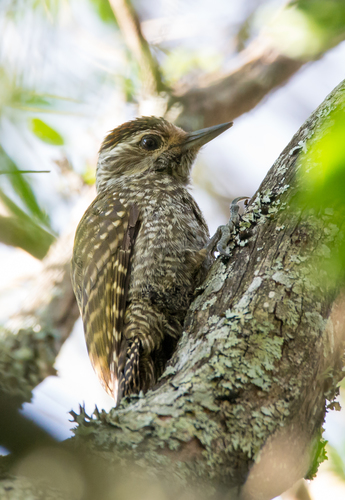
White-spotted Woodpecker
Veniliornis spilogaster
A charming, 'polka-dotted' resident of South American woodlands, the White-spotted Woodpecker is a master of the canopy. With its vibrant red crown and striking barred chest, it brings a touch of wild elegance to any backyard camera setup.
Quick Identification
Size
Length of 17–19 cm (6.7–7.5 in); weight ranges from 35–45 g (1.2–1.6 oz).
Colors
Olive-green upperparts with fine white spotting; underparts are densely barred with black and white. Males have a red crown and nape, while females have a dark olive-brown crown.
Key Features
- Fine white spots across olive wings and back
- Bold black-and-white horizontal barring on the belly
- Distinctive white post-ocular stripe
- Male has a vibrant red crown
When You’ll See Them
Geographic range
Where Does the White-spotted Woodpecker Live?
Native to the lush southeastern regions of South America, the White-spotted Woodpecker is a quintessential resident of the Atlantic Forest biome. Its core range spans across southeastern Brazil, stretching from Minas Gerais down to Rio Grande do Sul, and extends westward into eastern Paraguay and northeastern Argentina. It is also a common sight in the wooded landscapes of Uruguay, making it one of the most widely distributed small woodpeckers in the Southern Cone's humid zones.
Basemap © OpenStreetMap contributors
Behavior
The White-spotted Woodpecker is an active and somewhat social bird, often seen moving through the mid-to-high canopy in pairs or as part of mixed-species foraging flocks. Unlike some of its more reclusive relatives, this species is quite adaptable and has become a familiar sight in suburban gardens and parks where mature trees are present. They are known for their rhythmic tapping and short, sharp vocalizations that help them maintain contact with their mate while foraging.
When searching for food, they use a combination of gleaning—picking insects off the surface of bark—and light hammering to reach larvae tucked away in crevices. They generally exhibit a curious but cautious nature toward humans. While they won't usually approach a person directly, they are remarkably tolerant of backyard activity, often continuing their search for insects while being observed from a porch or patio.
EverydayEarth exclusive
Camera Tips
To capture high-quality footage of the White-spotted Woodpecker, focus your camera on vertical structures. These birds are most likely to be seen spiraling up the trunks of medium-sized trees or navigating the undersides of horizontal branches. Mount your camera about 5 to 7 feet high on a neighboring tree, angled slightly upward to capture their underbelly barring and head movements. Because they are relatively small, a camera with a fast trigger speed and a high-resolution sensor is essential for capturing their quick, jerky movements.
In a backyard setting, you can significantly increase your chances by placing your camera near a 'lure.' While they don't typically visit seed feeders, they are highly attracted to suet blocks, especially those containing dried insects or fruit. Alternatively, a birdbath with a solar-powered dripper or fountain can be a magnet for them, as the sound of moving water is irresistible for bathing and drinking in the midday heat.
Lighting is your best friend with this species. Their white spots and olive plumage can blend into the shadows of dense foliage, so try to position your camera facing a trunk that receives dappled morning sunlight. Set your camera to 'Burst Mode' or 'Photo + Video' mode; the initial photo captures the still identification details, while the video allows you to observe their characteristic 'hitch-and-tap' climbing behavior.
Similar Species
Species that look similar or are commonly confused with White-spotted Woodpecker.
Frequently Asked Questions
Record White-spotted Woodpecker at your habitat
Connect a camera to start building your own species record — AI identifies every visitor automatically.