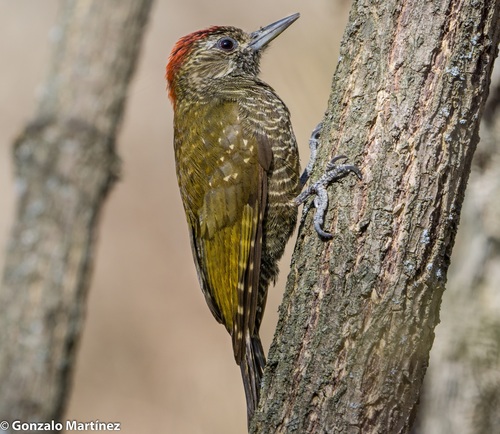
Dot-fronted Woodpecker
Veniliornis frontalis
A hidden gem of the Andean cloud forests, the Dot-fronted Woodpecker is a small, energetic climber known for its uniquely speckled brow and olive-hued wings. It is a master of the Yungas canopy, bringing life and rhythm to the montane woodlands of Argentina and Bolivia.
Quick Identification
Size
13-16 cm (5.1-6.3 in) in length; weighs approximately 25-35 grams (0.9-1.2 oz)
Colors
Olive-brown upperparts, yellowish-white barred underparts, white dots on the forehead. Males have a red nape and crown patch.
Key Features
- Distinctive white dots on a dark forehead
- Heavily barred yellow and olive underparts
- Small, straight grey bill
- Olive-green wings without prominent spots
When You’ll See Them
Geographic range
Where Does the Dot-fronted Woodpecker Live?
Native to the South American continent, the Dot-fronted Woodpecker is found in a relatively narrow strip along the eastern slopes of the Andes Mountains. Its core population resides within the lush Yungas forests of southern Bolivia and northwestern Argentina. It is a sedentary species, remaining in these high-altitude subtropical regions throughout the year without any known introduced populations elsewhere.
Basemap © OpenStreetMap contributors
Behavior
The Dot-fronted Woodpecker is an energetic and nimble bird, characteristic of the subtropical forests of the Andes. It is most frequently observed in the middle to upper layers of the canopy, where it hitches its way up trunks and along horizontal branches with quick, jerky movements. Unlike larger woodpeckers that create loud, echoing drums, this species produces a softer, more rapid tapping as it searches for hidden larvae under the moss and bark of cloud forest trees.
Socially, they are often found in pairs or as part of mixed-species foraging flocks, traveling alongside tanagers and woodcreepers. They are relatively vocal for their size, using a series of sharp 'tsip' or 'peek' calls to maintain contact with their mate. While generally wary of open spaces, they are increasingly seen in suburban gardens that border native woodlands, provided there are enough mature trees to offer cover and food.
EverydayEarth exclusive
Camera Tips
To successfully capture the Dot-fronted Woodpecker on camera, focus your efforts on vertical structures. Mount your AI camera roughly 1.5 to 2.5 meters high on the trunk of a native tree, ideally one with rough bark or slight moss coverage. Angle the camera slightly upward to capture the bird's underside markings, which are key for identification. These woodpeckers are drawn to 'edge habitats,' so placing your camera near the boundary between a garden and a wooded area increases your chances of a sighting.
While they are primarily insect-eaters, you can entice them closer to your camera lens using suet. In the southern Andean climate, use a high-quality, heat-resistant suet block or 'bark butter' pressed directly into the crevices of the tree bark. This encourages the bird to stay in the frame for a longer duration compared to a hanging feeder, allowing the AI to capture a clear, high-resolution image of the white forehead dots.
Set your camera to a fast trigger speed and enable burst mode. Because these birds move with rapid, hitching motions, a slow camera will often result in a blur or a photo of a tail disappearing out of frame. The best lighting occurs in the early morning hours when the sun hits the mid-canopy; ensure your camera is positioned so the sun is behind it to illuminate the subtle olive and red colors of the plumage.
Similar Species
Species that look similar or are commonly confused with Dot-fronted Woodpecker.
Frequently Asked Questions
Record Dot-fronted Woodpecker at your habitat
Connect a camera to start building your own species record — AI identifies every visitor automatically.