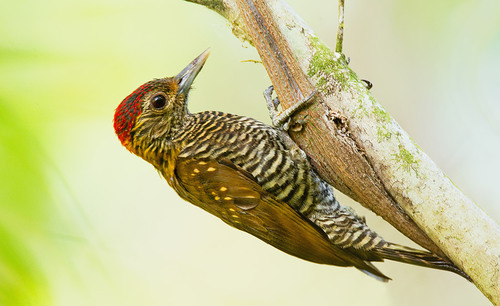
Golden-collared Woodpecker
Veniliornis cassini
A small but striking inhabitant of the Amazonian canopy, the Golden-collared Woodpecker is named for its brilliant yellow nape and olive-bronze plumage. This nimble forager is a master of disguise in the sun-dappled leaves of the Guiana Shield.
Quick Identification
Size
Length 15–16 cm (5.9–6.3 in); Weight approximately 26–36 g (0.9–1.3 oz)
Colors
Olive-bronze upperparts, golden-yellow hindneck collar, and brown-and-white barred underparts. Males have a red crown; females have a dark crown with white speckles.
Key Features
- Bright golden-yellow collar on the back of the neck
- Olive-green to bronze wings and back
- Heavily barred underparts
- Small, straight chisel-like beak
When You’ll See Them
Geographic range
Where Does the Golden-collared Woodpecker Live?
The Golden-collared Woodpecker is native to the northern regions of South America. Its core range is centered in the Guiana Shield and the northern Amazon Basin, covering the countries of Guyana, Suriname, French Guiana, and southern Venezuela. It is also widely distributed across northern Brazil, specifically in the states of Amazonas, Pará, and Amapá, where it remains a year-round resident in the lush, evergreen lowlands.
Basemap © OpenStreetMap contributors
Behavior
The Golden-collared Woodpecker is an active and somewhat elusive resident of the tropical canopy. Unlike some of its more boisterous relatives, it moves with a quiet efficiency, hitching rapidly up tree trunks and along slender branches. It is frequently seen as a member of mixed-species foraging flocks, traveling alongside woodcreepers and tanagers to take advantage of the communal protection and the insects stirred up by the group.
These birds are primarily solitary or found in pairs, maintaining territories through soft drumming and sharp vocalizations. While they are not known for being bold around human settlements, they will readily explore garden edges that feature mature native trees or proximity to primary forest. Their flight is characteristic of the family—a series of rapid flaps followed by a short glide, creating a dipping, undulating path through the air.
EverydayEarth exclusive
Camera Tips
Capturing the Golden-collared Woodpecker requires moving your camera off the ground and into the mid-story. Mount your device on the trunk of a mature, rough-barked tree at a height of at least 8 to 12 feet. Aim the lens slightly downward or across the trunk to catch the bird as it hitches upward. Because this species is small and moves quickly, a high shutter speed is essential to prevent motion blur during its rapid pecking motions.
To attract them to a specific spot, look for 'snags' or standing dead wood on your property. These are natural magnets for woodpeckers looking for larvae. You can also try a vertical suet feeder or a specialized 'woodpecker block' smeared with nut butters, though native forest birds in South America can be more cautious with artificial feeders than North American species. A more reliable attractant is a 'tree dripper'—a water source that slowly trickles down the bark, as these birds often seek out moisture trapped in tree crevices.
Position your camera to take advantage of the morning light, as this is when their olive-bronze feathers and golden collars will be most vibrant. Use the 'burst mode' setting if your camera supports it; since these birds are constantly turning their heads to look for predators, taking 3-5 photos per trigger increases your chances of getting a clear shot of the male’s red crown or the female’s speckled head for proper identification.
Similar Species
Species that look similar or are commonly confused with Golden-collared Woodpecker.
Red-stained Woodpecker
Lacks the golden collar on the hindneck and has distinct red patches on the wing coverts.
Little Woodpecker
Smaller in size with more brownish upperparts and lacks the bright yellow nape.
Yellow-throated Woodpecker
Much larger bird with a bright yellow throat and face, rather than just a collar.
Frequently Asked Questions
Record Golden-collared Woodpecker at your habitat
Connect a camera to start building your own species record — AI identifies every visitor automatically.