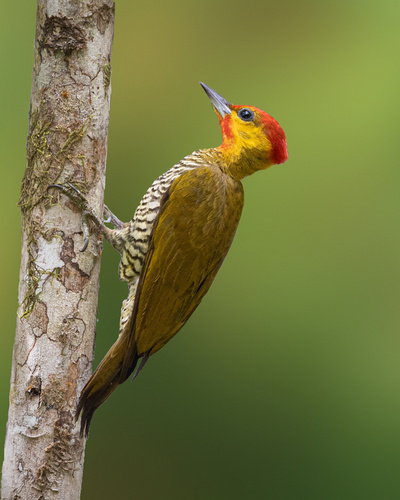
Yellow-throated Woodpecker
Piculus flavigula
A golden-throated marvel of the Amazon, this woodpecker is a master of the forest canopy. With its striking barred belly and vibrant yellow plumage, it is a prized sight for any wildlife enthusiast.
Quick Identification
Size
Length: 19–20 cm (7.5–8 in); Weight: 42–63 g (1.5–2.2 oz)
Colors
Olive-green back and wings, golden-yellow throat and neck sides, white underparts with heavy green barring. Males have a red crown and mustache.
Key Features
- Bright golden-yellow throat and side-neck patches
- Olive-green upperparts with cream and green barred belly
- Male features a red crown and malar (mustache) stripe
- Relatively short, dark, chisel-like bill
When You’ll See Them
Geographic range
Where Does the Yellow-throated Woodpecker Live?
The Yellow-throated Woodpecker is a quintessential South American resident, spanning the vast Amazon Basin and the Guiana Shield. Its core range includes the tropical lowlands of Brazil, Peru, Colombia, and Venezuela, extending into the forested regions of Ecuador, Bolivia, and the Guianas. You will primarily find them in undisturbed humid forests where tall canopies provide ample foraging opportunities.
Basemap © OpenStreetMap contributors
Behavior
The Yellow-throated Woodpecker is a methodical and somewhat quiet member of the Picidae family. Unlike some of its more boisterous cousins, this species often forages silently or with soft tapping, moving steadily along limbs and trunks in the middle and upper layers of the forest canopy. They are frequently observed in pairs or as part of larger, mixed-species foraging flocks, traveling alongside tanagers and woodcreepers to exploit insect outbreaks.
Socially, they are monogamous and highly territorial during the breeding season. They excavate their own nesting cavities in dead trees or rotting branches, usually several meters above the ground. While they are generally shy around human settlements, they can become accustomed to observers in eco-lodges or forest edges where the habitat remains intact.
EverydayEarth exclusive
Camera Tips
Capturing a Yellow-throated Woodpecker on camera requires height and patience. Since this species prefers the mid-to-upper canopy, standard ground-level trail camera setups will rarely see them. If you have a safe way to mount a camera 10 to 20 feet up a tree trunk—ideally one with visible termite nests or soft, decaying wood—you significantly increase your chances. Angle the camera slightly downward to capture the bird's profile as it hitches upward along the bark.
Because they are attracted to the activity of other birds, placing your camera near a known fruiting tree or a permanent forest water source can be effective. They don't typically visit standard bird feeders, but they are highly attracted to dead standing timber (snags). Look for trees with existing small holes or peeling bark and focus your lens on these 'high-traffic' foraging spots.
Set your camera to a high trigger speed or 'burst mode.' Woodpeckers move their heads with incredible velocity when drumming or searching for ants, and a slow shutter can result in a golden-yellow blur. If your camera supports video, 20-second clips are ideal for capturing their unique 'hitching' movement and the rhythmic tapping they use to locate prey.
Lighting is your biggest challenge in the rainforest. Try to position the camera so it faces away from the morning sun to avoid silhouetting the bird against the bright sky. If possible, use a camera with a high-quality CMOS sensor that handles the dappled, low-light conditions of the forest interior without losing the vibrant yellow detail of the bird's throat.
Similar Species
Species that look similar or are commonly confused with Yellow-throated Woodpecker.
Frequently Asked Questions
Record Yellow-throated Woodpecker at your habitat
Connect a camera to start building your own species record — AI identifies every visitor automatically.