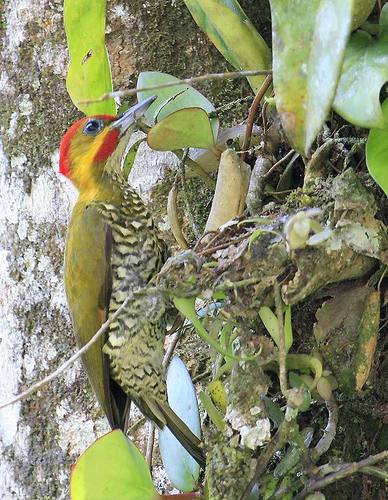
White-throated Woodpecker
Piculus leucolaemus
A colorful resident of the Amazonian canopy, the White-throated Woodpecker is known for its striking white throat and its habit of joining mixed-species flocks in the deep forest.
Quick Identification
Size
19-20 cm (7.5-8 inches) in length; weighs approximately 45-60 g (1.6-2.1 oz).
Colors
Bronzy-green upperparts and wings; distinctive white throat; yellowish-gold stripe below the eye; olive and cream barred underparts. Males have a red crown and nape; females have red only on the hindneck.
Key Features
- Bright white throat patch
- Yellowish 'mustache' stripe
- Bronzy-green back with olive-barred belly
- Small, pointed bill for gleaning
When You’ll See Them
Geographic range
Where Does the White-throated Woodpecker Live?
The White-throated Woodpecker is a native resident of the South American tropics, specifically concentrated within the vast Upper Amazon Basin. Its core range encompasses the humid lowlands of eastern Colombia, eastern Ecuador, eastern Peru, and northern Bolivia, extending eastward into the western and central Amazonian regions of Brazil. This species is a non-migratory specialist of the deep rainforest, thriving in the continuous canopy of some of the world's most biodiverse wilderness areas.
Basemap © OpenStreetMap contributors
Behavior
The White-throated Woodpecker is a relatively quiet and discreet member of the woodpecker family, often found inhabiting the middle and upper layers of the rainforest canopy. Unlike many of its louder relatives, this species rarely engages in heavy, resonant drumming. Instead, it is frequently observed as a quiet participant in mixed-species foraging flocks, moving through the trees alongside woodcreepers and tanagers to find its next meal.
Its movement is characterized by methodical climbing and occasional short, dipping flights between branches. It is generally a solitary bird or found in pairs, maintaining a low profile that makes it a rewarding challenge for birdwatchers to spot. Interactions with humans are rare due to its preference for deep forest interiors, though it may occasionally be seen near forest edges or clearings in protected areas.
EverydayEarth exclusive
Camera Tips
Capturing a White-throated Woodpecker on camera requires a strategy focused on verticality and canopy access. Because this species spends most of its time in the mid-to-upper story of the forest, mounting your camera at ground level will rarely yield results. Instead, look for leaning trunks or large, moss-covered branches at a height of 10 to 20 feet. If you are using a trail camera in a backyard setting near a forest edge, try to position it facing a known 'snag' or a dead tree where insects are likely to congregate.
While they are not typical visitors to seed feeders, you can entice them by mimicking their natural foraging environment. Placing a suet block high on a tree trunk or applying a specialized bird-safe nectar or paste into the crevices of rough bark can sometimes draw them into the camera's field of view. Be sure to set your camera's trigger speed to the fastest possible setting, as their movements are often quick and jerky as they hop from one bark crevice to the next.
Timing is critical for high-quality images. The White-throated Woodpecker is most active during the early morning hours just after sunrise. Position your camera to face away from the rising sun to avoid lens flare. Because the rainforest floor and mid-story can be quite dark, a camera with a high-quality CMOS sensor and a fast lens (low f-stop) is essential for capturing the fine details of their barred plumage without motion blur. If your camera has a 'burst' or 'multi-shot' mode, enable it to ensure you catch the bird in a pose that clearly shows the white throat and crown color.
Similar Species
Species that look similar or are commonly confused with White-throated Woodpecker.
Frequently Asked Questions
Record White-throated Woodpecker at your habitat
Connect a camera to start building your own species record — AI identifies every visitor automatically.