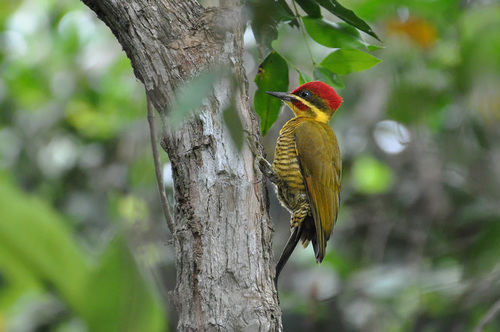
Golden-green Woodpecker
Piculus chrysochloros
With its shimmering olive-gold plumage and striking facial stripes, the Golden-green Woodpecker is a hidden gem of the South American canopy. This ant-eating specialist brings a touch of metallic brilliance to the humid lowland forests it calls home.
Quick Identification
Size
18–21 cm (7–8.3 in) in length; weighs approximately 44–75 g (1.6–2.6 oz)
Colors
Olive-green upperparts with a golden gloss; yellowish underparts with fine olive barring; males feature a red crown and malar stripe; both sexes have a distinct buffy-yellow facial stripe.
Key Features
- Distinctive buffy-yellow stripe from bill to ear
- Golden-olive back and wings
- Finely barred yellow and olive underparts
- Male has red crown and nape
When You’ll See Them
Geographic range
Where Does the Golden-green Woodpecker Live?
Native to the lush tropical landscapes of Central and South America, the Golden-green Woodpecker occupies a vast territory stretching from the southern reaches of Panama across the heart of the Amazon Basin. Its core population resides in the forested regions of Brazil, Peru, and Colombia, though it is a resident in nearly every mainland South American nation except for Chile and Uruguay. This species is primarily a lowland specialist, thriving in the dense, humid interiors and sun-dappled edges of the continent's diverse rainforest systems.
Basemap © OpenStreetMap contributors
Behavior
The Golden-green Woodpecker is a relatively shy and quiet member of the Picidae family. Unlike its more boisterous relatives, it often moves through the canopy with a methodical, almost stealthy pace. It is typically observed foraging alone or in pairs, hitching its way up tree trunks and along larger horizontal branches in search of its preferred prey. While it is a forest bird, it rarely joins large mixed-species flocks, preferring to maintain its own territory in the middle to upper levels of the forest.
Its communication is characterized by soft, rising whistles and occasional rhythmic drumming, though it drums less frequently than many other woodpeckers. In the presence of humans, it tends to stay high in the canopy or move to the opposite side of a tree trunk to remain out of sight. Because it is a resident species, it remains in the same general territory year-round, making it a reliable subject for local observers once its favorite foraging trees are identified.
EverydayEarth exclusive
Camera Tips
To capture the elusive Golden-green Woodpecker, your camera placement should focus on the 'mid-story' of the forest—typically between 10 and 15 feet (3 to 5 meters) off the ground. These birds are vertical specialists, so mount your camera directly onto the trunk of a sturdy tree, ideally one with rough bark or visible signs of insect life. Using a tree-climbing mount or a strap that allows for a downward tilt will help you capture the bird as it hitches upward in its characteristic undulating fashion.
Because this species is a specialist in ants and termites, look for trees that host arboreal termite nests or have 'ant highways' running up the trunk. If you are on a property with dead snags, these are gold mines; the Golden-green Woodpecker often returns to the same dead wood to forage or drum. Unlike some larger woodpeckers, they are relatively quiet, so you shouldn't rely on sound to trigger your camera; instead, use a high-sensitivity PIR (Passive Infrared) sensor setting to catch their quick movements.
Lighting is your best friend when it comes to showcasing their namesake golden-olive hue. Position your camera facing north or south to avoid direct lens flare while benefiting from the soft, angled light of the morning and late afternoon. Set your camera to a fast trigger speed (0.2s or less) and use 'Burst Mode' to capture 3–5 photos per trigger. This ensures that even if the bird is mid-peck or moving its head rapidly, you’ll get at least one crisp, clear shot of its intricate facial markings and the metallic sheen of its feathers.
Similar Species
Species that look similar or are commonly confused with Golden-green Woodpecker.
Frequently Asked Questions
Record Golden-green Woodpecker at your habitat
Connect a camera to start building your own species record — AI identifies every visitor automatically.