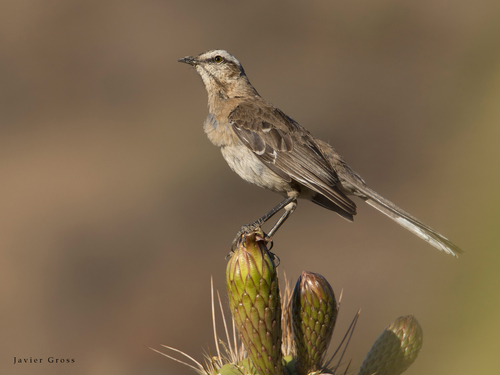
Chilean Mockingbird
Mimus thenca
Meet the 'Tenca,' Chile's premier avian impersonator. With its long tail and legendary singing voice, this charismatic mockingbird is a staple of backyards from the Atacama to the Lake District.
Quick Identification
Size
Length of 26-29 cm (10-11.5 inches); Weight approx. 60-70g (2.1-2.5 oz)
Colors
Brownish-gray upperparts with darker streaks; pale grayish-white underparts; dark malar stripe and a white eyebrow (supercilium); tail is dark with white tips on outer feathers
Key Features
- Slender, slightly down-curved dark bill
- Prominent white tips on outer tail feathers visible in flight
- Dark line through the eye and pale eyebrow
- Long, expressive tail often held upright
When You’ll See Them
Geographic range
Where Does the Chilean Mockingbird Live?
Native to the South American continent, the Chilean Mockingbird is primarily found along the western side of the Andes. Its core range encompasses the northern and central regions of Chile, stretching from the Atacama Desert in the north down to the Los Lagos region in the south. While it is considered a Chilean signature species, smaller populations and occasional sightings have been recorded in neighboring parts of western Argentina, particularly in the Neuquén province.
Basemap © OpenStreetMap contributors
Behavior
The Chilean Mockingbird, or 'tenca,' is a bold and highly intelligent songbird famous for its vocal versatility. It is a master mimic, capable of weaving the calls of other birds, domestic animals, and even mechanical noises into its long, complex melodic sequences. During the breeding season, males are particularly conspicuous, perched atop the highest available branches or fence posts to broadcast their territorial songs across the landscape.
On the ground, these birds are energetic and inquisitive. They move with a distinctive series of hops, often pausing to tilt their heads or flick their wings to flush out insects. While they are generally territorial and seen in pairs, they have adapted remarkably well to human presence, often becoming quite tame in suburban gardens and parks where they are known to investigate potential food sources provided by residents.
EverydayEarth exclusive
Camera Tips
To capture high-quality footage of the Chilean Mockingbird, place your camera at a relatively low height, roughly 1 to 1.5 meters (3-5 feet) off the ground. These birds spend a significant amount of time foraging on the floor or perched on low shrubs, so an angled-down approach towards a clear patch of ground or a flat-topped stone is often more effective than pointing the camera high into the canopy.
Luring a tenca to your lens is best achieved using a shallow birdbath or a steady water source, as they are frequent drinkers and bathers in the dry Mediterranean climate of central Chile. If you are using food as a lure, fresh fruit like halved grapes, apple slices, or native berries will reliably attract them. They are also attracted to mealworms, which can trigger the bird's natural 'flicking' behavior, making for dynamic video content.
Because the Chilean Mockingbird is fast-moving, set your AI camera to a high trigger speed and use a burst mode (3-5 photos per trigger) to ensure you catch the moment they spread their tail feathers, revealing the diagnostic white tips. Since they are most active during the cooler morning hours, position your camera facing north or south to avoid the harsh glare of the low-angled sun, which can wash out the subtle gray-brown tones of their plumage.
In suburban settings, look for 'song perches'—prominent, exposed points like the corner of a roof, a tall fence post, or a bare branch. Placing a camera with a wide-angle lens near these spots can capture the bird in full song, often with its characteristic throat-swelling displays. During the spring months (September-November), keep the camera active all day, as the birds are hyper-active and less cautious while defending territories.
Similar Species
Species that look similar or are commonly confused with Chilean Mockingbird.
Frequently Asked Questions
Record Chilean Mockingbird at your habitat
Connect a camera to start building your own species record — AI identifies every visitor automatically.