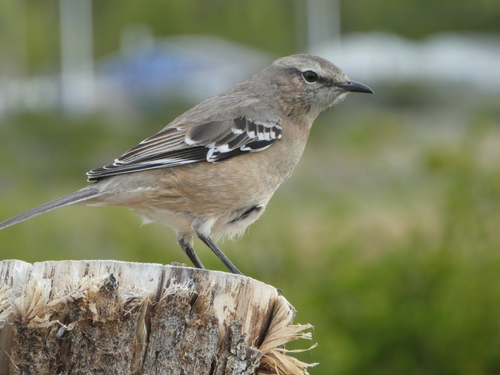
Patagonian Mockingbird
Mimus patagonicus
Meet the soulful songster of the southern plains. The Patagonian Mockingbird is a master of mimicry and a bold backyard companion found across the rugged landscapes of Argentina and Chile.
Quick Identification
Size
Length: 23-26 cm (9-10.2 inches); Weight: 50-65 g (1.7-2.3 oz)
Colors
Soft brownish-gray upperparts; pale grayish-white underparts; dark tail with white outer feathers; subtle white wing bars; yellow-orange iris.
Key Features
- Slender bill slightly curved downward
- Long, dark tail with conspicuous white tips on outer feathers
- Pale eyebrow (supercilium) contrasting with a darker eye-stripe
- Uniform grayish-brown back without heavy streaking
When You’ll See Them
Behavior
The Patagonian Mockingbird is a charismatic and vocal resident of the southern scrublands, often seen perching prominently on bushes or fence posts to survey its territory. Like its cousins, it is a master mimic, weaving the calls of other birds and even mechanical sounds into its own complex, melodic song. They are highly territorial during the breeding season and will often perform "wing-flashing" displays, where they hitch their wings upward in a series of jerky motions to reveal hidden patches, a behavior thought to startle insects or signal to rivals.
In backyard settings, these birds are quite bold and curious. They spend much of their time on the ground, running with great agility rather than hopping, as they search for food. While they are social with their mates, they tend to be solitary or found in pairs, maintaining a watchful eye over their chosen territory from a high vantage point. Their flight is typically low and undulating, moving from one thicket to the next.
EverydayEarth exclusive
Camera Tips
To capture the best footage of a Patagonian Mockingbird, place your camera approximately 2 to 3 feet off the ground. Since these birds are prolific ground-foragers, a low-angle shot allows you to capture their unique running gait and the distinctive way they cock their tails. Aim the lens toward an open patch of dirt or short grass near a native fruiting bush, such as Calafate or Schinus, which are natural magnets for this species during the colder months when insects are scarce.
Lighting is crucial for highlighting their subtle gray plumage and those striking yellow eyes. Position your camera facing north or south to avoid the harsh glare of the low Patagonian sun, which can wash out the delicate textures of their feathers. If you are using a triggered camera, set a short burst mode or a 10-to-15 second video clip; they move quickly and often pause just long enough for a perfect still before darting after a grasshopper. A high shutter speed is recommended if your camera allows it, as their movements are often sudden and jerky.
If you want to lure them into frame, a shallow birdbath is often more effective than a traditional seed feeder. Patagonian Mockingbirds are attracted to the sight and sound of moving water, especially in arid environments. Setting your camera near a dripping water feature during the early morning hours will almost certainly guarantee a visit. During the winter, offering small pieces of fruit or suet can also encourage them to linger in front of the lens. Avoid placing cameras in deep thickets where their camouflage makes them hard to distinguish; instead, look for the edges of clearings where they transition from cover to open ground.
Similar Species
Species that look similar or are commonly confused with Patagonian Mockingbird.
Frequently Asked Questions
Record Patagonian Mockingbird at your habitat
Connect a camera to start building your own species record — AI identifies every visitor automatically.