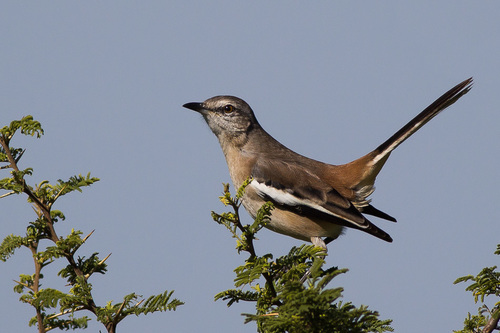
White-banded Mockingbird
Mimus triurus
A master of mimicry with a flash of silver, the White-banded Mockingbird is the virtuoso of the South American scrublands. Watch for its dramatic white wing patches as it dances through the air, performing a symphony of stolen songs.
Quick Identification
Size
Length: 20-23 cm (8-9 in); Wingspan: 30-35 cm (12-14 in); Weight: 45-55 g (1.6-1.9 oz)
Colors
Upperparts are a soft greyish-brown; underparts are creamy white; wings feature prominent broad white bands; tail has dark central feathers with striking white outer feathers. Sexes are monomorphic (look alike).
Key Features
- Broad white wing bands visible in flight and at rest
- White outer tail feathers contrasting with dark center
- Slender, slightly decurved black bill
- Pale buff or cinnamon wash on the flanks
When You’ll See Them
Behavior
The White-banded Mockingbird is celebrated as one of South America's most accomplished vocalists. Like its relatives, it is a master mimic, capable of weaving the calls of dozens of other bird species into its own complex, melodic song. During the breeding season, males are known for their 'song-flights,' where they leap into the air from a perch, wings flashing white, while singing loudly to defend their territory or attract a mate.
While they can be bold and inquisitive around human dwellings, they are generally more migratory than other mockingbird species. In the southern parts of their range, such as central Argentina, they are summer residents that head north toward the tropics when the weather cools. They are socially monogamous and highly protective of their nesting sites, often chasing away much larger birds or domestic pets that venture too close.
EverydayEarth exclusive
Camera Tips
To capture the stunning white wing flashes of the White-banded Mockingbird, position your camera at a mid-level height, roughly 3 to 5 feet off the ground. These birds are frequent ground-foragers but prefer to land on a transitional perch—like a low fence rail or a sturdy shrub branch—before dropping to the grass. Aiming your camera at these 'landing strips' will give you the clearest, most stable shots of their plumage.
Water is the single best attractant for this species. A birdbath with a solar-powered dripper or a small fountain is irresistible to them. Place your camera 4-6 feet away from the water source, ensuring the lens is at eye level with the bird. Because they are incredibly fast-moving, use a 'Burst Mode' or a high-speed trigger setting to capture the moment they spread their wings to bathe, which is when the namesake white bands are most visible.
If you are using video mode, pay close attention to the audio settings. Since the White-banded Mockingbird is a champion singer, capturing its vocalizations is just as important as the visuals. Avoid placing the camera near noisy air conditioning units or busy roads. Early morning, just after sunrise, is the 'golden hour' for both lighting and song activity.
During the southern winter (May-August), you can lure them toward your camera using native fruit-bearing plants or supplemental suet and chopped fruit. They are less likely to visit standard seed feeders but will readily investigate a platform feeder offering raisins or halved oranges. Set your camera's PIR (motion sensor) sensitivity to high, as their slender frames and quick movements can sometimes fail to trigger sluggish sensors.
Similar Species
Species that look similar or are commonly confused with White-banded Mockingbird.
Chalk-browed Mockingbird
Lacks the broad white wing bands and has a very prominent white stripe above the eye.
Patagonian Mockingbird
Generally larger with a more uniform grey-brown color and much less white in the tail and wings.
Long-tailed Mockingbird
Found further north in Ecuador and Peru; has a noticeably longer tail and different wing markings.
Frequently Asked Questions
Record White-banded Mockingbird at your habitat
Connect a camera to start building your own species record — AI identifies every visitor automatically.