Chinaberry
Melia azedarach
The Chinaberry is a stunning but controversial resident of the backyard landscape, famous for its fragrant lilac blooms and clusters of golden winter berries. While its rapid growth provides quick shade, its hardy nature makes it a formidable presence in many ecosystems.
Quick Identification
Size
Height of 6–15 m (20–50 ft) with a canopy spread of 6–10 m (20–33 ft)
Colors
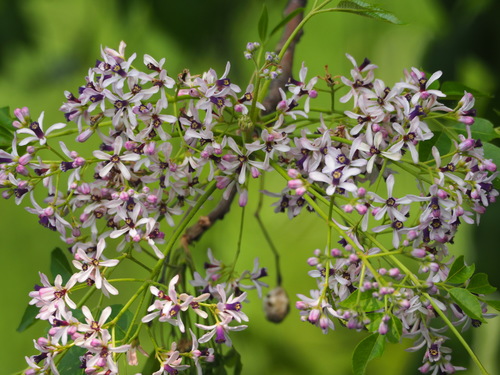
Glossy dark green leaves; pale purple or lilac flowers with dark centers; yellowish-tan marble-like berries
Key Features
- Large bipinnate (double-compound) leaves up to 2 feet long
- Clusters of fragrant five-petaled lilac flowers
- Hard, round yellow berries that persist through winter
- Deeply furrowed dark brown bark
When You’ll See Them
Geographic range
Where Does the Chinaberry Live?
Native to the Indomalaya and Australasia regions, the Chinaberry has been widely introduced across the globe as an ornamental shade tree. It is now firmly established throughout the southern United States, from Virginia down to Florida and west to California, as well as across much of Mexico. Additionally, robust naturalized populations thrive in the temperate and subtropical regions of South Africa, South America, and southern Europe, where the tree often escapes cultivation to inhabit roadsides and woodland margins.
Basemap © OpenStreetMap contributors
Behavior
The Chinaberry is a fast-growing deciduous tree known for its ornamental beauty and its aggressive ability to colonize new areas. In the spring, it produces a profusion of lilac-scented flowers that attract various pollinators. As the seasons progress, these flowers turn into hard, yellow drupes (berries) that remain on the branches long after the leaves have fallen, providing a stark visual against the winter sky.
While it is often planted for shade, the Chinaberry has a complex relationship with local ecosystems. Its berries contain neurotoxins that are poisonous to humans and many mammals, yet they are frequently consumed by certain bird species. In some regions, the tree is considered invasive because its leaf litter raises soil pH and its dense canopy outcompetes native vegetation through rapid growth and the release of allelopathic chemicals that inhibit other plants.
EverydayEarth exclusive
Camera Tips
To capture the best images of a Chinaberry tree and the wildlife it attracts, mount your camera on a nearby structure or a neighboring tree at a height of 5 to 8 feet. Angle the lens slightly upward toward the berry clusters, especially during the winter months when the leaves are gone. This positioning is ideal for capturing visiting birds like Cedar Waxwings or Robins that may stop by to feed on the fruit.
Because the Chinaberry has long, flexible branches that sway easily in the wind, you may experience many false triggers. To combat this, set your camera's PIR (passive infrared) sensitivity to 'Medium' or 'Low' and use 'Zone Masking' if your camera supports it, focusing the trigger area on the sturdier trunk or a specific high-traffic branch rather than the outer twigs.
During the spring flowering phase, use a macro lens setting if available or move the camera closer to a low-hanging flower cluster. This will allow you to capture the various butterflies and bees attracted to the fragrant purple blooms. Since the tree provides dense shade in the summer, ensure your camera is positioned to take advantage of the 'golden hour' light (early morning or late afternoon) to avoid harsh shadows and underexposed shots under the canopy.
Similar Species
Species that look similar or are commonly confused with Chinaberry.
Frequently Asked Questions
Record Chinaberry at your habitat
Connect a camera to start building your own species record — AI identifies every visitor automatically.