Chinese witch-hazel
Hamamelis mollis
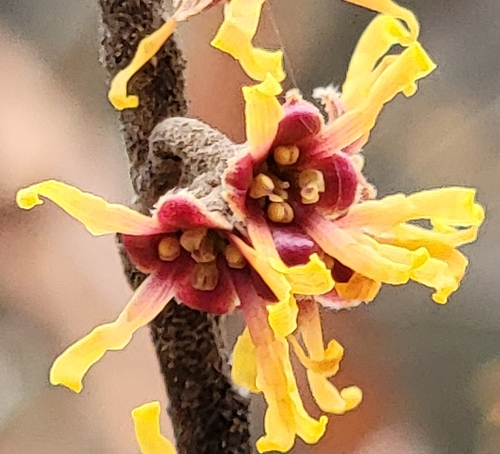
The Chinese witch-hazel is a winter-blooming icon, famous for its intense citrus fragrance and golden, spider-like flowers that emerge while snow is still on the ground.
Quick Identification
Size
A deciduous shrub or small tree reaching 3 to 5 meters (10 to 15 feet) in height and spread.
Colors
Bright golden-yellow petals with a reddish-purple calyx cup; foliage is dark green, turning rich yellow in autumn.
Key Features
- Fragrant yellow flowers with four ribbon-like, crinkled petals
- Broad, oval leaves with a soft, felt-like hairy underside
- Blooms on bare branches in late winter (January to March)
- Distinctive zig-zagging branch pattern with gray-brown bark
When You’ll See Them
Geographic range
Where Does the Chinese witch-hazel Live?
Native to the temperate forest regions of central and eastern China, this species thrives naturally in provinces like Hubei, Sichuan, and Zhejiang. It is typically found growing in the dappled light of woodland margins and mountainous thickets. Due to its stunning winter display, it has been widely introduced and naturalized in temperate gardens across North America and Europe, where it is a favorite for urban landscaping.
Basemap © OpenStreetMap contributors
Behavior
The Chinese witch-hazel is famous for its 'thermoperiodic' floral behavior. To survive the freezing temperatures of late winter, its delicate ribbon-like petals have the remarkable ability to curl up tightly like tiny springs when the temperature drops and unfurl again as soon as the air warms. This protects the reproductive parts from frost damage while ensuring the plant is ready to greet any early-emerging pollinators on sunny days.
As a garden inhabitant, it is a slow-growing but incredibly hardy species. It remains largely dormant throughout the summer and autumn, but its fragrant blossoms provide a critical nectar source in the heart of winter. It interacts with the local ecosystem by attracting queen bumblebees and hoverflies that have been stirred by unseasonably warm winter spells, acting as a vital early-season food station.
EverydayEarth exclusive
Camera Tips
To capture the stunning winter blooms of the Chinese witch-hazel, position your camera at a height of 3 to 5 feet, focusing on a branch with dense flower clusters. Since these plants bloom on bare wood, the background can often look 'busy' or brown; try to angle your camera so the yellow flowers are framed against a dark evergreen or a solid-colored fence to make the colors pop. If using an AI-powered camera, setting it to a higher sensitivity for motion during the day can help you catch rare shots of winter insects or birds investigating the fragrant blooms.
Lighting is the most important factor for this species. The ribbon-like petals are thin and semi-translucent, making them look magical when back-lit by the low-angled winter sun. Aim your camera toward the east for morning light or west for afternoon 'golden hour' shots. If your camera allows for manual focus, lock onto a single flower cluster to capture the fine, crinkled texture of the petals, which are often missed by wide-angle landscape shots.
Seasonal placement is key for a year-round profile. In the spring and summer, the plant produces large, fuzzy leaves that may block the view of other wildlife behind it. If you are using the camera to monitor a trail, ensure the camera is placed at least 6 feet away from the shrub to account for the spring growth spurt. In autumn, the leaves turn a brilliant yellow, providing a great opportunity for color-triggered captures before the spectacular winter flowering begins again.
Similar Species
Species that look similar or are commonly confused with Chinese witch-hazel.
Frequently Asked Questions
Record Chinese witch-hazel at your habitat
Connect a camera to start building your own species record — AI identifies every visitor automatically.