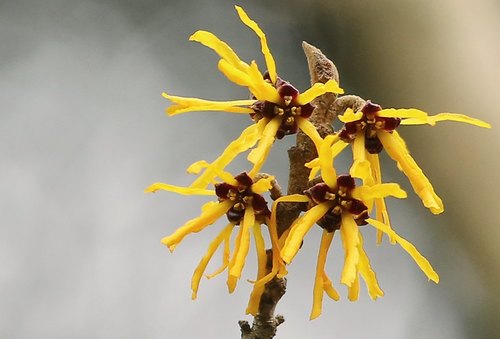
Japanese Witch-Hazel
Hamamelis japonica
A burst of gold in the heart of winter, the Japanese Witch-Hazel is a hardy shrub that brings life to frozen landscapes. Its fragrant, ribbon-like flowers are a beacon for early pollinators and a delight for backyard observers.
Quick Identification
Size
Grows to a height and spread of 10-15 feet (3-4.5 meters), often taking a wide, vase-like or rounded shape.
Colors
Bright yellow petals with a purplish-red calyx cup at the center; medium green leaves that turn vibrant yellow in the fall.
Key Features
- Four spindly, crinkled petals per flower
- Late winter blooming on leafless branches
- Broad, scalloped leaves that resemble hazel foliage
When You’ll See Them
Behavior
The Japanese Witch-Hazel is a resilient deciduous shrub that serves as one of the first signs of life in a sleeping winter garden. While most plants remain dormant, this species unfurls its unique, spidery blossoms as early as January or February. One of its most fascinating adaptations is its ability to protect its delicate petals; during extreme cold snaps, the petals curl tightly inward, then unfurl again as soon as the temperature rises, ensuring the flowering process isn't ruined by a late frost.
In the backyard ecosystem, this plant acts as a vital bridge for early-emerging insects. Because it blooms when few other nectar sources are available, it often attracts the season's first flies and bees on unseasonably warm winter days. Humans have long valued the shrub not just for its aesthetic beauty and light fragrance, but for its hardy nature, as it requires very little maintenance once established in temperate climates.
EverydayEarth exclusive
Camera Tips
Capturing the Japanese Witch-Hazel on an AI-powered camera offers a unique challenge since the 'subject' is stationary, but the action is subtle. To truly appreciate its beauty, set your camera to time-lapse mode during the late winter months. Position the camera about 3 to 5 feet away from a cluster of flower buds. By capturing a frame every 30 minutes, you can create a stunning video of the crinkled petals unfurling as the sun warms the branches. Ensure your camera is angled slightly upward to catch the bright yellow flowers against a crisp blue winter sky or the contrast of falling snow.
For those interested in the wildlife that visits the Japanese Witch-Hazel, use a high-sensitivity motion setting. Because the pollinators at this time of year (like winter-active gnats or early bees) are small, a close-up focal lens or a camera with a high-resolution sensor is essential. Place the camera on the side of the shrub that receives the most morning sun, as this is where the flowers will open first and where insects will congregate for warmth. Avoid placing the camera too low; a height of 4 to 6 feet is usually perfect for capturing the mid-section of the shrub where the bloom density is highest.
In the autumn, you can transition your camera to capture the foliage change. The Japanese Witch-Hazel turns a brilliant gold, providing a perfect backdrop for backyard birds. To get the best shots during this season, aim the camera toward the interior of the shrub where songbirds like Chickadees or Nuthatches may seek cover. Use a fast shutter speed if your camera allows it, as the movement of birds against the yellow leaves can be quite rapid. Always check your lens for condensation during the transition from cold nights to sunny mornings, which is common during its peak blooming season.
Similar Species
Species that look similar or are commonly confused with Japanese Witch-Hazel.
Frequently Asked Questions
Record Japanese Witch-Hazel at your habitat
Connect a camera to start building your own species record — AI identifies every visitor automatically.