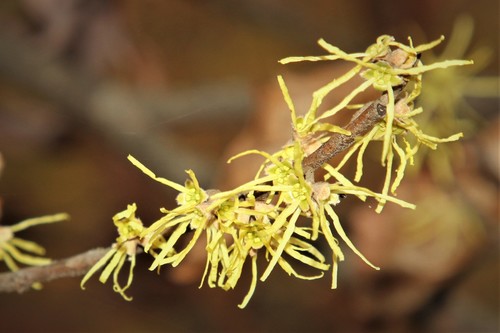
american witch-hazel
Hamamelis virginiana
A winter-blooming wonder of the eastern woods, American witch-hazel defies the seasons with its golden, ribbon-like petals and explosive seed pods. It is a vital late-season sanctuary for pollinators and a hallmark of North American woodland heritage.
Quick Identification
Size
Height: 4.5–9 meters (15–30 feet); Spread: 4.5–6 meters (15–20 feet)
Colors
Bright yellow ribbon-like flowers; copper-gold autumn foliage; smooth, silvery-gray to brown bark
Key Features
- Distinctive spindly, yellow petals that bloom in late fall
- Broad, oval leaves with wavy margins and asymmetrical bases
- Woody, two-beaked seed capsules that explode when mature
- Sprawling, multi-stemmed growth habit
When You’ll See Them
Geographic range
Where Does the american witch-hazel Live?
Native to the eastern half of North America, the American witch-hazel thrives in temperate climates from the maritime provinces of Canada down to the Gulf Coast. Its core range extends from Nova Scotia and Ontario in the north, stretching westward to the Great Lakes and Minnesota, and reaching south through the Appalachian Mountains into northern Florida and eastern Texas. It is a quintessential understory species of the great eastern deciduous forests, often found hugging the banks of shaded creeks or colonizing the edges of woodland clearings.
Basemap © OpenStreetMap contributors
Behavior
One of its most fascinating traits is its method of seed dispersal. The woody capsules from the previous year's flowers take a full year to mature. When they finally dry out, they contract and violently eject their black, glossy seeds at speeds of up to 30 mph, launching them up to 30 feet away from the parent plant. This 'explosive' behavior ensures the next generation isn't competing for the same patch of soil.
EverydayEarth exclusive
Camera Tips
To capture the unique beauty of American witch-hazel on camera, timing is everything. Unlike most flora, you'll want to focus your efforts in late October through early December. Position your camera to face the shrub from a low angle, aiming for the spindly yellow flowers against a darker background like a cedar tree or a shaded forest floor. This contrast is essential for the thin, ribbon-like petals to show up clearly in digital photos.
If you are using a trail camera to document wildlife interactions, place the device about 3 feet off the ground and roughly 5 feet away from a cluster of blooms. This is the 'sweet spot' for capturing the owlet moths and late-season insects that visit the flowers at night. Because these pollinators are active in low light, ensure your camera has a high-quality infrared flash or a 'night-pro' setting to avoid motion blur from the fluttering wings.
For those interested in the 'explosive' seed dispersal, look for the woody brown capsules that formed during the previous season. These usually pop open on dry, sunny days in late autumn. Set your camera to high-speed burst mode or high-frame-rate video (60fps or higher) and focus on a cluster of closed pods. It requires patience and a bit of luck, but catching a seed mid-launch is a prized shot for any backyard naturalist. During the winter, the shrub also serves as a favorite perching spot for northern cardinals and chickadees, making it a great location for year-round bird photography.
Similar Species
Species that look similar or are commonly confused with american witch-hazel.
Frequently Asked Questions
Record american witch-hazel at your habitat
Connect a camera to start building your own species record — AI identifies every visitor automatically.