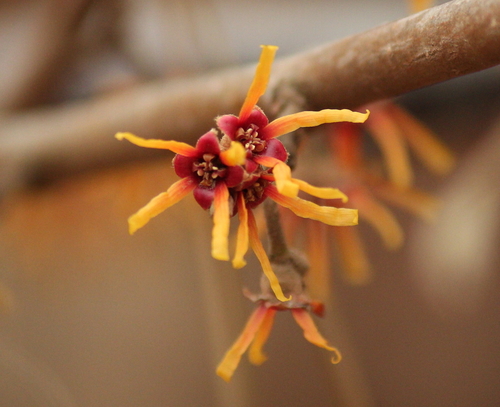
ozark witch-hazel
Hamamelis vernalis
A defiant burst of color in the heart of winter, the Ozark witch-hazel fills the crisp air with a spicy fragrance while other plants still sleep. This resilient native shrub is the ultimate signal that spring is just around the corner.
Quick Identification
Size
A large multi-stemmed shrub reaching 6 to 13 feet (1.8 to 4 m) in height and spreading 10 to 15 feet (3 to 4.5 m) wide.
Colors
Leathery dark green summer leaves; golden-yellow fall foliage; flowers feature yellow, orange, or copper-red ribbon-like petals with a dark red interior.
Key Features
- Clusters of fragrant, ribbon-like flowers appearing in mid-winter
- Petals that curl up during extreme cold to protect from frost
- Smooth, greyish-brown bark on older stems
- Explosive woody seed capsules that 'fire' seeds up to 30 feet away
When You’ll See Them
Behavior
Ozark witch-hazel is famous for being a 'harbinger of spring,' often blooming while snow is still on the ground. Unlike most plants that wait for warmth, this hardy shrub uses the quiet of winter to its advantage, opening its citrus-scented flowers as early as January. Its most fascinating behavioral trait is its response to temperature; on bitter cold days, the spindly petals curl tightly into a ball to prevent freeze damage, unfurling again as soon as the sun warms the air.
Beyond its winter display, this shrub is a master of seed dispersal. In late summer or autumn, the woody seed pods from the previous year’s flowers dry out and contract. This creates a mechanical tension that eventually snaps, audibly 'shooting' two shiny black seeds away from the mother plant. This strategy, known as explosive dehiscence, helps the species colonize new areas along the rocky stream beds where it naturally thrives.
EverydayEarth exclusive
Camera Tips
Capturing the Ozark witch-hazel on camera requires a bit of patience and a focus on seasonal changes. Because this shrub blooms when most other life is dormant, it provides a rare opportunity for winter time-lapse photography. Set your camera on a sturdy tripod or mount it to a nearby post focusing on a specific branch of flower buds. During late January or February, use a time-lapse setting to capture the ribbon-like petals unfurling during the day and curling back up at night. The contrast of the bright yellow or copper flowers against a backdrop of snow or dark winter woods is visually stunning.
If you are interested in the wildlife that visits this plant, position your camera with a macro lens or a close-focus setting. Even in the dead of winter, the fragrance of the Ozark witch-hazel attracts specialized winter-active moths and flies. Aim your camera at a cluster of flowers during the warmest part of the afternoon to catch these hardy pollinators in action. For trail cameras, a low-angle shot looking up through the branches can highlight the structure of the shrub and the way light filters through the translucent petals.
Another excellent time for camera observation is late summer when the seed pods are ripening. If you can identify a pod that looks nearly ready to burst, you can set your camera to high-speed video mode. While difficult to time perfectly, capturing the moment a seed pod 'fires' its contents is a trophy shot for any backyard naturalist. Ensure you have plenty of light, as the seeds move exceptionally fast.
Lastly, don't ignore the fall foliage. The Ozark witch-hazel turns a brilliant, butter-yellow. This is the best time to check your camera’s white balance settings to ensure the gold tones don't appear washed out. Place the camera to catch the 'golden hour' light (shortly before sunset) to make the leaves glow against the darker shadows of the garden.
Similar Species
Species that look similar or are commonly confused with ozark witch-hazel.
Frequently Asked Questions
Record ozark witch-hazel at your habitat
Connect a camera to start building your own species record — AI identifies every visitor automatically.