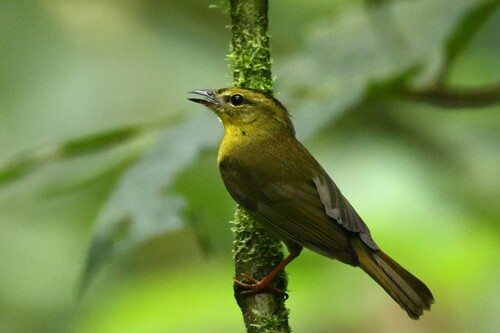
Choco Warbler
Myiothlypis chlorophrys
A vibrant yellow gem of the humid Pacific forests, the Choco Warbler is a master of the tropical understory. Watch for its golden crown and restless energy among the mossy branches of Colombia and Ecuador.
Quick Identification
Size
12.5–13.5 cm (5 in); weight approx. 12-15g (0.4-0.5 oz)
Colors
Olive-green upperparts, bright yellow underparts, orange-yellow crown stripe, and yellow 'spectacles' around the eyes
Key Features
- Bright yellow underparts contrasting with olive back
- Distinctive orange-yellow crown stripe bordered by black
- Bold yellow eye-ring and eyebrow
- Restless, jerky movement in the understory
When You’ll See Them
Geographic range
Where Does the Choco Warbler Live?
The Choco Warbler is a specialty of the humid Chocó bioregion in South America. It is native to the Pacific slopes of the Andes, with its core populations found in western Colombia and western Ecuador. Because it is a resident species, it does not migrate, remaining in these wet, evergreen forest belts throughout the year.
Basemap © OpenStreetMap contributors
Behavior
The Choco Warbler is a highly active and restless bird, spending most of its day flitting through the dense understory of humid forests. It is most frequently observed in pairs or small family groups, rarely venturing far from the protection of thick foliage. These birds move with a characteristic jerky motion, often flicking their wings and tails as they hop between mossy branches and leaf litter in search of prey.
While not overtly shy, they are secretive by nature, preferring the dim light of the forest interior over open clearings. They are vocal birds, often giving away their location with sharp 'tsip' calls or a hurried, trilling song that rises and falls. In their social interactions, they are known to occasionally join mixed-species foraging flocks, moving alongside other insectivores to capitalize on disturbed insects.
EverydayEarth exclusive
Camera Tips
To capture the Choco Warbler on a trail camera, placement is everything. Since these birds are understory specialists, you should mount your camera very low—ideally between 1 and 3 feet off the ground. Point the lens toward horizontal, moss-covered logs or low-hanging branches near a forest stream, as these are their favorite foraging 'highways.'
Because they live in the shaded forest interior, lighting can be a major hurdle. Set your camera in a spot where small 'sunflecks' hit the forest floor, or use a camera with a high-quality CMOS sensor that performs well in low-light conditions. Increasing the trigger speed to its fastest setting is vital, as these warblers are constant movers and rarely stay in the frame for long.
One of the best ways to attract a Choco Warbler to a specific spot is with water. A small, shallow basin with a solar-powered dripper or 'wiggler' to create surface ripples is irresistible to them for bathing and drinking. Place the water feature in a quiet, shaded corner with plenty of nearby shrubs for the bird to retreat into if it feels threatened.
Video mode is often more rewarding than still photos for this species. A 10-to-15 second clip will capture their unique tail-flicking behavior and their quick, darting flight patterns. If your camera has a high-sensitivity microphone, you may also capture their distinctive trilling songs, which can help confirm identification in a busy forest environment.
Similar Species
Species that look similar or are commonly confused with Choco Warbler.
Frequently Asked Questions
Record Choco Warbler at your habitat
Connect a camera to start building your own species record — AI identifies every visitor automatically.