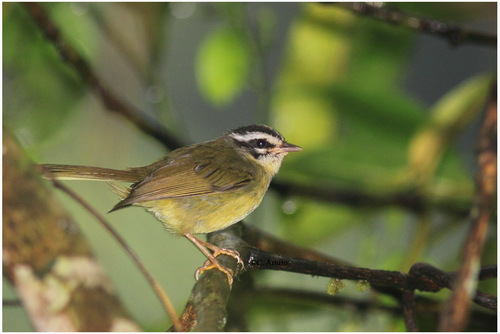
Three-striped Warbler
Basileuterus tristriatus
A social spark plug of the Andean cloud forest, the Three-striped Warbler is famous for leading mixed-species flocks through the mountain mist. With its bold racing stripes and endless energy, it is a rewarding find for any backyard observer.
Quick Identification
Size
13 cm (5.1 in) in length; weighs approximately 10–13 g (0.35–0.46 oz)
Colors
Olive-green upperparts and yellowish-white underparts; head features three distinct stripes (two black, one buffy-yellow in the center). No significant sexual dimorphism.
Key Features
- Three bold black and buff crown stripes
- Olive-green wings and back
- Pale yellow to buffy underparts
- Short, thin insect-eating bill
- Highly active, tail-flicking movement
When You’ll See Them
Behavior
These birds primarily inhabit the forest understory and mid-levels, where they move with a restless, hopping gait. They are known for flicking their wings and tails as they forage, a behavior that might help flush out hiding insects. While they are forest birds, they are quite adaptable and will frequently visit shaded gardens and coffee plantations that provide enough canopy cover.
EverydayEarth exclusive
Camera Tips
To successfully capture the Three-striped Warbler on a backyard or trail camera, focus your efforts on the 'transition zones' where thick shrubbery meets a more open garden path. These birds are wary of wide-open spaces but love patrolling the edges of dense vegetation. Mount your camera at eye level—roughly 4 to 5 feet off the ground—and aim it at a horizontal branch that has been cleared of obstructing leaves. This gives the bird a natural 'landing strip' within your camera's focal range.
Because this species is small and extremely fast, standard PIR (passive infrared) sensors can sometimes be too slow to trigger. Use a camera with a trigger speed of 0.2 seconds or faster, and set it to 'Burst Mode' to take 3–5 photos per trigger. This increases your chances of getting a crisp shot rather than a blurred tail-end. Since they are attracted to the sound of water, placing a small solar-powered fountain or a 'dripper' in a shaded area is the most effective way to lure them into a stationary position for a clear photo.
Lighting is another critical factor in the dense Andean forests they call home. If your camera is placed in a very shaded area, the birds might appear as dark silhouettes. Try to position the camera so the morning sun (from 7:00 AM to 9:00 AM) illuminates the 'stage' from behind the camera. If you are using a professional AI camera, ensure the sensitivity is set to 'high' for small animals so the sensor picks up their rapid, light movements.
Similar Species
Species that look similar or are commonly confused with Three-striped Warbler.
Frequently Asked Questions
Record Three-striped Warbler at your habitat
Connect a camera to start building your own species record — AI identifies every visitor automatically.