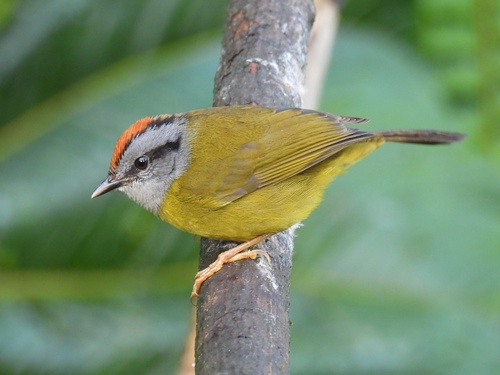
Russet-crowned Warbler
Myiothlypis coronata
A vibrant spark in the Andean undergrowth, the Russet-crowned Warbler is famous for its glowing yellow belly and its namesake chestnut cap. This energetic songbird is a staple of South American cloud forests and a delightful find for any backyard observer.
Quick Identification
Size
13–14 cm (5.1–5.5 inches) in length; 11–15 grams (0.39–0.53 oz)
Colors
Bright yellow underparts; olive-grey upperparts; grey face with a prominent russet or chestnut crown stripe bordered by thin black lines. Sexes are similar in appearance.
Key Features
- Distinctive chestnut-colored crown stripe
- Bright yellow chest and belly
- Thin black border framing the russet crown
- Grey facial plumage with no prominent eyebrow
- Active wing-flicking behavior
When You’ll See Them
Behavior
The Russet-crowned Warbler is a lively and charismatic resident of the Andean cloud forests. Unlike many North American warblers that migrate thousands of miles, this species is a permanent resident of its tropical mountain home. It is most frequently observed in the lower to middle strata of the forest, where it moves with high energy through dense undergrowth, secondary thickets, and forest edges.
These birds are highly social and are almost always found in pairs or small family groups. They are also quintessential members of mixed-species foraging flocks, often seen traveling alongside tanagers and woodcreepers. While they aren't particularly shy of humans, their constant movement and preference for thick vegetation can make them a challenge to spot without the help of a motion-activated camera.
EverydayEarth exclusive
Camera Tips
To capture the Russet-crowned Warbler, positioning is everything. Focus your camera on the 'understory layer'—the zone between three and six feet off the ground. These birds rarely venture into the high canopy, preferring to stick to the dense shrubbery where they feel protected. Look for natural flyways, such as narrow openings in the brush or where a garden meets a forest edge, and mount your camera on a steady branch or post at chest height.
Water is the single best attractant for this species. In the montane regions where they live, a shallow, dripping birdbath or a natural forest seep is a magnet. They are frequent bathers and will visit a reliable water source daily to clean their plumage. Setting your camera to 'Video Mode' or 'Burst Mode' near a water feature will allow you to capture their rapid movements and the striking flash of their yellow bellies as they splash.
Since they are insectivores, traditional seed feeders won't attract them. Instead, focus on creating an insect-friendly 'micro-habitat' in front of your lens. A pile of native leaf litter or a selection of native flowering shrubs will naturally attract the invertebrates they hunt. Avoid using loud playback calls to lure them, as this can cause unnecessary stress; instead, rely on their natural curiosity and habit of following established foraging routes through your property.
For the best image quality, ensure your camera is positioned to take advantage of early morning light. The soft, angled sun of the first two hours of the day will illuminate the russet crown, which can often look dark or dull in the deep shade of the forest. Use a fast trigger speed setting, as these birds are known for their constant wing-flicking and tail-wagging, which can result in motion blur on slower devices.
Similar Species
Species that look similar or are commonly confused with Russet-crowned Warbler.
Frequently Asked Questions
Record Russet-crowned Warbler at your habitat
Connect a camera to start building your own species record — AI identifies every visitor automatically.