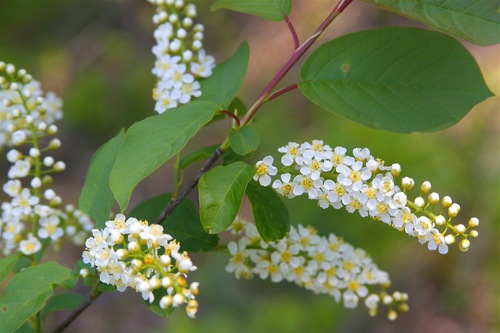
chokecherry
Prunus virginiana
A cornerstone of the North American backyard, the chokecherry provides a spectacular spring bloom followed by a late-summer feast that draws in everything from songbirds to black bears.
Quick Identification
Size
Typically 3-20 feet (1-6 meters) tall; can occasionally reach 40 feet (12 meters) in ideal conditions.
Colors
Dark green glossy leaves; white flower clusters; fruit transitions from green to bright red to deep purple-black.
Key Features
- Cylindrical clusters of white flowers (racemes)
- Dark purple-black fruit in late summer
- Finely serrated oval leaves with two small glands at the petiole base
- Greyish-brown bark that becomes scaly or furrowed with age
When You’ll See Them
Geographic range
Where Does the chokecherry Live?
Chokecherry is one of the most widely distributed woody plants in North America, stretching from the Arctic Circle in Canada down to the mountains of Mexico. It is native across nearly the entire United States, though it is notably less common in the extreme Southeast and Gulf Coast regions. This hardy species thrives across diverse landscapes, from coastal plains to high-elevation mountain slopes, making it a ubiquitous sight in rural and suburban wild spaces alike.
Basemap © OpenStreetMap contributors
Behavior
Chokecherries are resilient, fast-growing shrubs or small trees that often form dense, suckering thickets. These thickets provide essential nesting sites and protective cover for numerous bird species and small mammals, creating a miniature ecosystem wherever they grow. In the spring, they serve as a vital nectar source, erupting in fragrant white blossoms that attract a diverse array of pollinators, including honeybees and various butterfly species.
As the season progresses, the blossoms give way to drooping clusters of fruit. While the raw berries are famously astringent and "choke" the palate for humans, they are a high-energy food source for wildlife. These plants act as a primary food hub during the late summer and autumn months as animals prepare for winter or migration, often being stripped of fruit within days of ripening.
EverydayEarth exclusive
Camera Tips
To capture the incredible biodiversity that visits a chokecherry, focus your camera on the fruit clusters during the late summer. Position your AI-powered camera on a tripod or a nearby branch roughly 4 to 6 feet off the ground, angled slightly downward toward a heavy cluster of ripening berries. High-speed trigger settings are vital here, as birds like Cedar Waxwings and Northern Flickers move quickly when feeding.
In areas where larger wildlife is present, place a second camera at a lower elevation—about 2 to 3 feet—near the base of the thicket. Chokecherries are a major attractant for black bears and deer, who will often stand on their hind legs or pull branches down to reach the fruit. Using a camera with a wide-angle lens can help capture these larger mammals in their entirety while they forage.
Lighting is key for identifying the glossy texture of the berries and the serrated edges of the leaves. Aim your camera North or South to prevent lens flare from the rising or setting sun. If your camera supports time-lapse, set it to take a shot every 15 minutes during the month of August; this will create a fascinating visual record of the 'ripening window' and show just how quickly the local bird population can harvest an entire tree.
Similar Species
Species that look similar or are commonly confused with chokecherry.
Frequently Asked Questions
Record chokecherry at your habitat
Connect a camera to start building your own species record — AI identifies every visitor automatically.