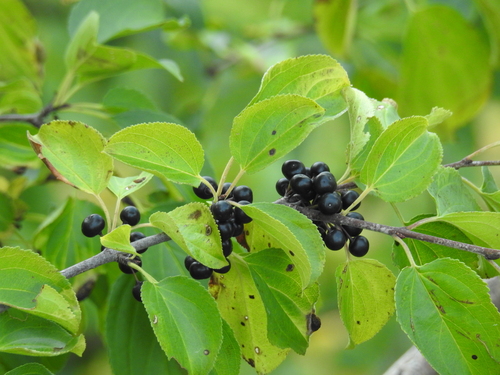
common buckthorn
Rhamnus cathartica
A hardy survivor from Europe and Asia, the common buckthorn has become a dominant fixture in North American landscapes. Known for its 'purging' black berries and sharp thorns, it is a fascinating example of botanical persistence.
Quick Identification
Size
A large shrub or small tree reaching heights of 6–7.5 metres (20–25 feet) with a trunk diameter up to 25 cm (10 inches).
Colors
Glossy dark green leaves; grey-brown bark with horizontal silvery lenticels; clusters of small, round black berries.
Key Features
- Twigs often end in a short, sharp thorn
- Leaves have 3–5 pairs of prominent veins that curve toward the tip
- Inner bark is a distinct, bright orange color
- Leaves are arranged in a sub-opposite pattern (not quite perfectly paired)
When You’ll See Them
Geographic range
Where Does the common buckthorn Live?
Common buckthorn is native to the temperate regions of Europe, northwest Africa, and western Asia, spanning from the British Isles and Scandinavia south to Morocco and east into Kyrgyzstan. Since its introduction to North America as an ornamental hedge in the early 19th century, it has become naturalized across the northern half of the United States and southern Canada. It is particularly prevalent throughout the Midwest and Northeast, where it is often categorized as a highly invasive species due to its ability to outcompete native flora.
Basemap © OpenStreetMap contributors
Behavior
Common buckthorn is an incredibly hardy and opportunistic species. It is one of the first plants to leaf out in the spring and one of the last to drop its leaves in the autumn, giving it a significant head start over native vegetation. This extended growing season allows it to shade out competitors, creating dense thickets that can eventually dominate a forest understory or suburban backyard.
Its reproductive strategy is equally aggressive. A single mature female plant can produce thousands of berries, which contain a chemical called emodin that acts as a potent laxative for birds. When birds consume the berries, the seeds pass through their digestive tracts rapidly, ensuring the seeds are dispersed far and wide along with a small amount of fertilizer. While humans find the plant invasive, it serves as a primary, if low-quality, food source and nesting site for many suburban bird species.
EverydayEarth exclusive
Camera Tips
Capturing the common buckthorn on camera is less about the plant's movement and more about using it as a biological 'hotspot' for other wildlife. Because buckthorn berries persist into the late autumn and winter, placing your camera near a fruiting female buckthorn is a guaranteed way to capture a variety of songbirds, including Cedar Waxwings and American Robins. Position the camera about 3 to 5 feet off the ground, angled slightly upward to capture the berry clusters and the birds that visit them.
If you are using an AI-powered camera to monitor plant health or invasive spread, try a time-lapse setting during the spring. This will highlight how much earlier buckthorn leaves out compared to native oaks or maples. For identification purposes, close-up shots of the twig tips are essential; look for the characteristic terminal thorn. If your camera has a macro mode, use it to document the serrated leaf margins and the curved vein patterns that are diagnostic for this species.
During the winter, the buckthorn's dark, 'peely' bark and silvery lenticels (horizontal slits) are very distinctive. Setting your camera to trigger on movement in the snow against a buckthorn backdrop can produce high-contrast, dramatic images of mammals like foxes or deer that use these thickets for cover. Remember to check your lens regularly, as the dense structure of buckthorn thickets can lead to spider webs or debris obscuring the view.
Similar Species
Species that look similar or are commonly confused with common buckthorn.
Frequently Asked Questions
Record common buckthorn at your habitat
Connect a camera to start building your own species record — AI identifies every visitor automatically.