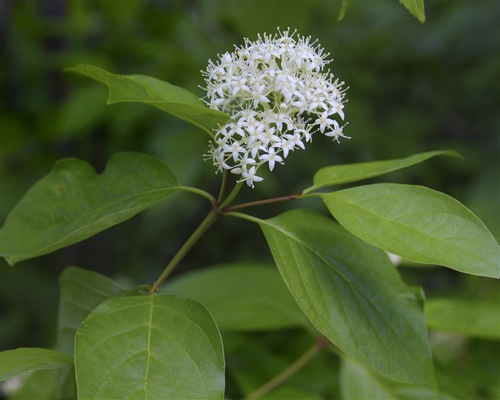
gray dogwood
Cornus racemosa
A champion of backyard biodiversity, the gray dogwood is a hardy shrub that transforms through the seasons, offering white blossoms in spring and striking red-stalked berries that fuel migratory birds.
Quick Identification
Size
3-4.5 meters (10-15 feet) in height and spread at maturity.
Colors
Creamy white flowers, white berries, bright red fruit stalks (pedicels), and grayish-brown bark.
Key Features
- Distinctive bright red fruit stalks that remain after berries are gone
- Creamy white flower clusters in a panicle or dome shape
- Opposite, lance-shaped leaves with veins that curve toward the tip
- Smooth gray bark on older stems, giving the plant its common name
- Small white fleshy drupes (berries) appearing in late summer
When You’ll See Them
Behavior
Gray dogwood is a resilient, colonial shrub that spreads through underground rhizomes to form dense thickets. Unlike many other dogwoods that prefer moist soil, the gray dogwood is remarkably adaptable, thriving in dry uplands just as easily as in wet meadows. In the spring, it produces a profusion of white flowers that act as a magnet for native bees and butterflies, while its dense branching structure provides excellent nesting sites for songbirds like Northern Cardinals and Gray Catbirds.
As the season progresses, the shrub undergoes a dramatic transformation. In late summer, it produces clusters of white berries. What makes this species particularly unique is the bright red color of the fruit stalks (pedicels). Even after birds have stripped the berries, these red 'skeletons' remain on the plant into the winter, providing a splash of color against the gray bark. Its social behavior is largely ecological; it acts as a foundational species in early-successional habitats, providing both cover and high-energy food for migrating wildlife.
EverydayEarth exclusive
Camera Tips
Gray dogwood is a 'stationery' subject that acts as a hub for wildlife. To capture the best footage, mount your camera on a nearby post or a sturdy branch roughly 4 to 5 feet off the ground, aiming directly at a cluster of ripening berries. Because the white berries are a high-fat food source, they attract a flurry of avian activity in the late summer and early fall. Setting your camera to 'burst mode' or short video clips will help you catch fast-moving birds like cedar waxwings or flickers as they hover to pluck the fruit.
Lighting is crucial when photographing this species. The white berries and creamy flowers can easily become overexposed in direct midday sun. Position your camera so it is south-facing to catch the golden hour light during the early morning or late afternoon, which will make the bright red fruit stalks pop against the gray bark. If your camera allows for exposure adjustment, slightly underexposing the shot can help preserve the detail in the white flower clusters.
Don't overlook the ground level. Because gray dogwood forms dense thickets, the area beneath the shrub is often a highway for small mammals like chipmunks and rabbits seeking cover. Placing a camera low to the ground (6-12 inches) near the base of the shrub can reveal the 'secret life' of creatures using the plant for protection. During the winter, keep your camera active; the remaining red stalks and dense branches provide beautiful contrast in the snow and continue to attract foraging birds searching for any missed berries.
Similar Species
Species that look similar or are commonly confused with gray dogwood.
Frequently Asked Questions
Record gray dogwood at your habitat
Connect a camera to start building your own species record — AI identifies every visitor automatically.