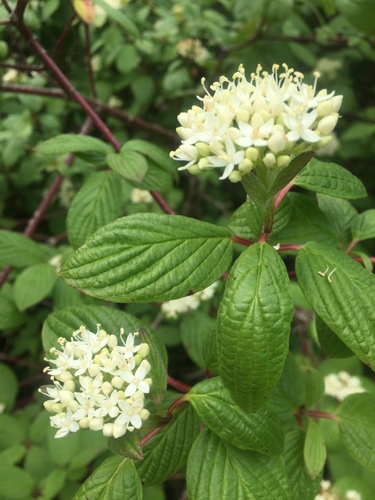
red osier dogwood
Cornus sericea
A champion of the winter landscape, the red osier dogwood offers a fiery burst of color against the snow while serving as an all-season buffet for backyard birds. Its dense thickets and nutritious berries make it one of the most valuable plants for supporting local biodiversity.
Quick Identification
Size
Grows 1.5–4 meters (5–13 feet) tall with a spread of 3 meters (10 feet) or more
Colors
Vibrant red to burgundy stems in winter; medium green leaves; creamy white flower clusters; white berries
Key Features
- Bright red bark that intensifies in color during winter months
- Opposite leaf arrangement with veins that curve toward the leaf tip
- Flat-topped clusters of small white flowers in late spring
- Small white berry-like drupes that ripen in late summer
When You’ll See Them
Behavior
Red osier dogwood is a resilient, deciduous shrub known for its multi-stemmed growth habit and its ability to spread via underground stolons. This colonial behavior allows it to form dense thickets, which are vital for local wildlife, providing essential cover and nesting sites for various bird species and small mammals. It is a fast-growing species that is particularly valued for its role in erosion control along waterways and moist hillsides.
As a seasonal performer, the plant undergoes a dramatic transformation throughout the year. In the spring and summer, it acts as a lush green backdrop for garden activity, blooming with nectar-rich flowers that attract a wide variety of pollinators. By autumn, its leaves turn a deep reddish-purple before falling to reveal the plant's most famous feature: the striking red bark. This color is most intense on younger stems, making the shrub a focal point of the winter landscape.
EverydayEarth exclusive
Camera Tips
Capturing the red osier dogwood on a backyard camera is less about the plant's movement and more about its role as a high-traffic hub for wildlife. To get the best shots, mount your camera at a height of 3 to 4 feet, angled slightly downward toward a cluster of berries in late summer. This is the prime time to catch cedar waxwings, flickers, and catbirds as they feast on the high-fat white drupes. During the winter, the red stems provide a stunning high-contrast background for shots of birds or rabbits; ensure your camera’s white balance is adjusted for snow to prevent the vibrant red from looking dull or washed out.
If you are using an AI-powered camera to identify visitors, place the unit about 5 to 8 feet away from the outer branches. This distance is close enough to trigger the sensor for small songbirds but wide enough to capture the architectural beauty of the shrub. Because this dogwood thrives in moist areas, ensure your camera housing is rated for high humidity if you are placing it near a stream or boggy area where the plant naturally grows. A north-facing orientation can help prevent lens flare when the sun is low during the winter months, keeping the red bark looking saturated and sharp.
For those interested in time-lapse photography, the red osier dogwood is an ideal subject. Set your camera to take one photo every few hours from late April through June to document the rapid leaf-out and flowering process. Alternatively, a winter time-lapse during a snowstorm can yield magical results as the white snow accumulates against the deep red stems. If you are trying to attract specific mammals, remember that deer often browse the twigs in winter; placing a camera near a well-established thicket can provide excellent nocturnal footage of foraging deer or elusive rabbits seeking cover.
Similar Species
Species that look similar or are commonly confused with red osier dogwood.
Frequently Asked Questions
Record red osier dogwood at your habitat
Connect a camera to start building your own species record — AI identifies every visitor automatically.