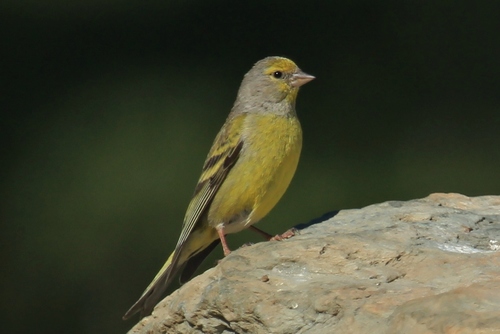
Citril Finch
Carduelis citrinella
Meet the 'Alpine Finch,' a high-altitude specialist known for its striking grey neck and vibrant yellow-green feathers. Living on the edge of the clouds, this social songbird brings life to Europe's most rugged mountain peaks.
Quick Identification
Size
Length: 12-12.5 cm (4.7-5 in); Wingspan: 22-25 cm (8.7-9.8 in); Weight: 10-14 g (0.35-0.5 oz)
Colors
Bright yellowish-green face and breast; distinctive blue-grey nape and sides of the neck; dark wings with two yellow bars; greyish beak.
Key Features
- Distinctive greyish-blue patch on the nape and neck
- Bright yellow-green underparts without heavy streaking
- Small, notched tail
- Conical grey bill specifically adapted for seeds
When You’ll See Them
Geographic range
Where Does the Citril Finch Live?
This specialized songbird is native to the high-mountain regions of Central and Southern Europe. Its core range is anchored in the Alps, the Pyrenees, and the Massif Central, with populations thriving across France, Switzerland, Austria, Germany, and Northern Spain. While they stay within Europe year-round, they are known for altitudinal migration, moving from high peaks down into lower valleys and even suburban edges during the harshest winter months.
Basemap © OpenStreetMap contributors
Behavior
The Citril Finch is an energetic and social songbird, almost always seen in small groups or family parties. They possess an undulating flight pattern common to finches, often accompanied by a metallic, rhythmic calling that helps the flock stay together as they move through the alpine canopy. While they spend much of their time in the safety of coniferous trees, they are frequently seen descending to the ground to forage in short grass or to drink from mountain springs.
During the breeding season, these birds exhibit a charming 'song-flight' where the male circles above his territory with slow, deliberate wingbeats while singing a thin, tinkling melody. They are generally less wary of humans than other alpine species, often visiting mountain huts or ski resorts where food is available, though they remain alert and will vanish into the pines at the first sign of a predator.
EverydayEarth exclusive
Camera Tips
Capturing the Citril Finch requires strategic placement based on the season. In the summer months, your best bet is placing cameras near the 'tree line' where forest transitions into meadow. Look for natural water seeps or shallow puddles on rocky paths; these birds are frequent drinkers and will often return to the same watering hole daily. Position the camera low—about 30-50 cm off the ground—angled toward a flat rock or clearing near the water to catch them while they bathe.
During the winter, if you live in a mountain valley, you can easily attract them to your backyard. Use a feeder filled with niger seeds or fine-cracked sunflower hearts. Mount your camera about 1-2 meters away from the feeder, ideally at eye level with a nearby 'perching branch.' Citril Finches rarely fly directly to a feeder; they prefer to land on a nearby twig to survey the area first. Capturing them on this natural perch makes for a much more professional wildlife photo than catching them on the plastic feeder itself.
Use a high-speed trigger setting or a short video clip mode (10-15 seconds). Because they are small and high-energy, their movements are lightning-fast. Ensure your camera is facing north or south to avoid the harsh mountain sun blowing out the delicate yellow and grey tones of their plumage. If your camera has AI bird detection, the Citril Finch's unique grey nape is a key identifier that helps the software distinguish it from the more common European Serin.
Similar Species
Species that look similar or are commonly confused with Citril Finch.
Frequently Asked Questions
Record Citril Finch at your habitat
Connect a camera to start building your own species record — AI identifies every visitor automatically.