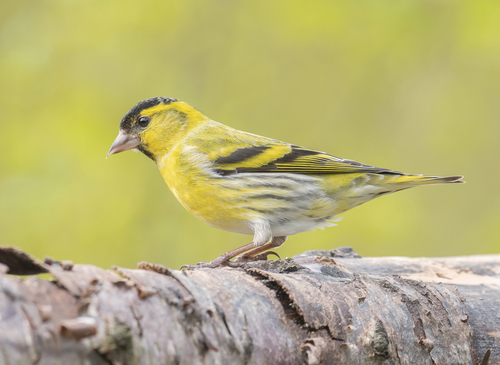
Eurasian Siskin
Spinus spinus
A vibrant, acrobatic finch that brings a splash of yellow to winter gardens. Known for its social nature and love of conifer seeds, the Eurasian Siskin is a delightful and energetic visitor for any backyard observer.
Quick Identification
Size
Length: 11–12.5 cm (4.3–4.9 in); Wingspan: 20–23 cm (7.9–9.1 in); Weight: 10–18 g (0.35–0.63 oz)
Colors
Males feature bright yellow-green plumage with a black crown and small black chin bib; females are duller grey-green with heavy dark streaking and no black crown.
Key Features
- Distinctive black crown and chin bib on males
- Prominent yellow patches on wings and tail sides
- Small, deeply notched tail and pointed bill
- Heavy dark streaking on the flanks and underparts
When You’ll See Them
Geographic range
Where Does the Eurasian Siskin Live?
The Eurasian Siskin is a widespread resident of the Palearctic, spanning the vast temperate forests of Europe and Northern Asia. Its native range stretches from the British Isles and Scandinavia across Russia to the Sea of Okhotsk and Japan. While they are year-round residents in much of Central and Western Europe, northern populations are known to migrate southward or westward during harsh winters, often appearing in massive numbers across the Mediterranean and Middle East when food supplies in the north fail.
Basemap © OpenStreetMap contributors
Behavior
The Eurasian Siskin is a highly energetic and acrobatic finch, often seen hanging upside down from thin branches or bird feeders to reach seeds. They are remarkably social birds, frequently traveling in large, restless flocks that can number in the hundreds during winter months. Their flight is characteristically bouncy and undulating, accompanied by constant high-pitched calling that keeps the group together.
In garden settings, they are initially shy but can become quite bold once they settle into a feeding routine. They exhibit a clear 'pecking order' at feeders, though they are generally less aggressive than larger finches like Greenfinches. Their presence in backyards is often irruptive, meaning they may appear in huge numbers one year and be nearly absent the next, depending on the success of the seed crop in their northern forest homes.
EverydayEarth exclusive
Camera Tips
To capture the best footage of Eurasian Siskins, place your AI-powered camera near hanging feeders, specifically those containing nyjer (thistle) seed or fine sunflower hearts. Because these birds are exceptionally agile and often feed while clinging to the mesh of a feeder or the tips of thin branches, positioning your camera at eye-level with the feeder (about 1.5-2 meters high) will provide the most intimate shots of their acrobatic displays. Ensure the camera is positioned at the minimum focal distance recommended by the manufacturer to get clear, sharp details of their plumage.
Siskins are very small and move with lightning speed, so use a high-speed trigger and burst mode if your camera supports it. Video mode is particularly rewarding with this species, as it captures their social interactions and constant 'twittering' vocalizations. If you are using a trail camera in a more natural setting, focus on the catkins of alder or birch trees during late winter; these are their favorite natural foraging spots, and the movement of the swaying branches often triggers the sensor effectively.
Because they are most likely to visit backyards in winter, lighting can be a challenge. Try to position the camera with the morning sun behind it to illuminate the male's bright yellow-green plumage. They are most active during the first few hours of daylight, so ensure your camera is ready and batteries are fresh before dawn. During 'irruption' years, you may see dozens of birds at once, so a wide-angle lens setting can help capture the chaotic beauty of a large flock feeding simultaneously.
Similar Species
Species that look similar or are commonly confused with Eurasian Siskin.
Frequently Asked Questions
Record Eurasian Siskin at your habitat
Connect a camera to start building your own species record — AI identifies every visitor automatically.