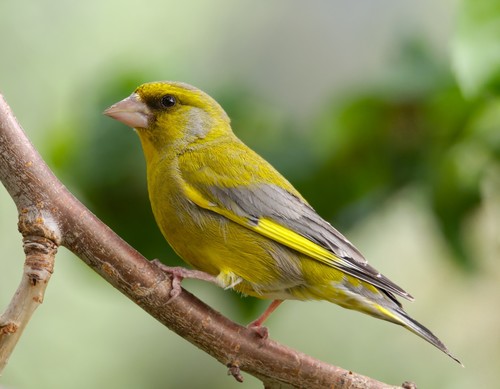
European Greenfinch
Chloris chloris
With its chunky build and flashes of lemon-yellow, the European Greenfinch is a cheerful mainstay of the garden bird table. A social and robust finch, it brings a splash of olive-green color and a distinctive wheezing song to backyards across Europe and beyond.
Quick Identification
Size
Length: 14–16 cm (5.5–6.3 in); Wingspan: 24.5–27.5 cm (9.6–10.8 in); Weight: 25–35 g (0.9–1.2 oz)
Colors
Adult males are a vibrant olive-green with bright yellow flashes on the primary wing feathers and the outer tail. Females and juveniles are duller, leaning towards a brownish-grey with more subtle yellow markings.
Key Features
- Heavy, pale conical bill designed for seed-cracking
- Bright yellow patches on the wing edges and tail sides
- Chunky, thick-necked silhouette compared to other finches
- Distinctive forked tail visible in flight
When You’ll See Them
Geographic range
Where Does the European Greenfinch Live?
The European Greenfinch is native across nearly the entire European continent, stretching from the northern reaches of Scandinavia down to the Mediterranean basin. Its natural range also extends into North Africa and Southwest Asia, including parts of Turkey and the Middle East. Beyond its native lands, this adaptable finch has been successfully introduced to Australia, New Zealand, and parts of South America, where it has established thriving feral populations in parklands and agricultural areas.
Basemap © OpenStreetMap contributors
Behavior
European Greenfinches are highly social and gregarious birds, particularly during the winter months when they form large roaming flocks to forage for food. They are a common sight in backyard settings, where they often assert dominance at bird feeders, using their larger size and stout bills to displace smaller species like Blue Tits or Goldfinches. Their flight is characteristic of finches—undulating and bouncy—but during the breeding season, males perform a distinctive 'butterfly flight' accompanied by a wheezing, nasal song.
These birds are well-adapted to human environments and are frequent visitors to garden bird tables and hanging feeders. While they are generally peaceful, they can be quite territorial and aggressive toward other birds during feeding sessions. In the spring, they are known for their varied song, which includes a mix of musical chirps and their signature long, drawn-out 'dweee' call.
Interestingly, the Greenfinch has become a staple of avian research regarding garden bird health. Because they are so social at feeders, they are often the primary species affected by certain avian diseases, making them an important indicator for the health of local bird populations. To help them thrive, humans are encouraged to maintain clean feeding stations.
EverydayEarth exclusive
Camera Tips
To capture the best footage of European Greenfinches, position your AI-powered camera approximately 1.5 to 2 meters (5 to 6.5 feet) away from a bird feeder. Since Greenfinches are heavy-billed and prefer larger seeds, they are most frequently seen on tube feeders containing black sunflower seeds or sunflower hearts. Setting the camera at eye level with the feeder perch will provide the most intimate and detailed views of their plumage and seed-cracking behavior.
Greenfinches are most active in the early morning shortly after sunrise. This time of day offers soft, warm lighting that makes the male's olive-green and yellow feathers pop against the background. Because they are social and often visit in small groups, use a wide-angle lens setting if your camera supports it to capture the 'jostling' interactions between birds as they compete for the best perch.
For trail cameras placed away from feeders, look for thick coniferous hedges or ivy-clad walls, which are their preferred nesting sites. Positioning a camera near a birdbath is also highly effective; Greenfinches are frequent drinkers and bathers, especially during the dry summer months. Capturing them mid-splash provides excellent high-action footage.
Given their quick, jerky movements, set your camera to a high shutter speed or use the 'Sports' or 'Action' mode if available. If your AI camera supports 'species-specific' triggering, ensuring it is tuned for small birds will help avoid missed shots. During winter, when natural food is scarce, you can attract them into the perfect camera frame by offering high-fat suet balls near your primary camera location.
Similar Species
Species that look similar or are commonly confused with European Greenfinch.
Eurasian Siskin
Much smaller with a daintier bill and prominent dark streaking on the flanks and belly.
European Serin
Smaller with a very short bill and a much more yellow, streaky appearance compared to the solid olive-green of the Greenfinch.
Common Chaffinch
Similar size but lacks the green/yellow body; males have a blue-grey cap and pinkish-red breast.
Frequently Asked Questions
Record European Greenfinch at your habitat
Connect a camera to start building your own species record — AI identifies every visitor automatically.