Cladophora
Cladophora glomerata
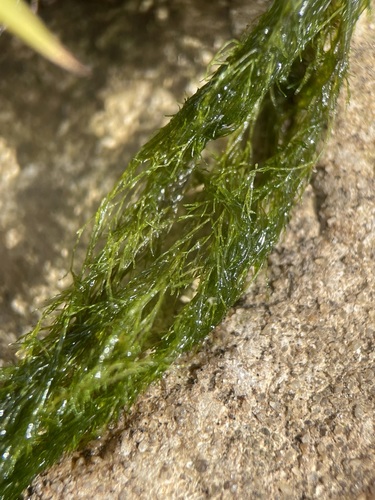
Often called 'Blanket Weed,' Cladophora glomerata is more than just pond scum—it is a vital aquatic ecosystem. This branching green alga provides food and shelter for a massive array of backyard pond inhabitants.
Quick Identification
Size
Individual filaments range from 10 cm to over 2 meters (4 inches to 6.5 feet) in length.
Colors
Vibrant grass-green when healthy, turning yellowish-green or brownish as it matures or traps sediment.
Key Features
- Branching filamentous structure visible to the naked eye
- Coarse, 'hairy' texture that feels rougher than slimy algae
- Attaches firmly to rocks, logs, or pond liners using a specialized basal cell
- Forms dense, billowing 'blanket' mats in slow-moving water
When You’ll See Them
Geographic range
Where Does the Cladophora Live?
Cladophora glomerata is a cosmopolitan species with a nearly global distribution. It is native across the Northern Hemisphere, found abundantly throughout North America, Europe, and Northern Asia, particularly in the Great Lakes region and major river systems. It has also established itself in temperate regions of the Southern Hemisphere, including parts of Australia, New Zealand, and South America, where it thrives in both natural and man-made water bodies.
Basemap © OpenStreetMap contributors
Behavior
Cladophora glomerata is a highly successful filamentous green alga that functions as a cornerstone of many freshwater ecosystems. Unlike many other algae that feel slimy to the touch, Cladophora has a distinctively coarse, stringy texture due to its reinforced cell walls. It primarily grows by attaching itself to solid substrates in sunlit, nutrient-rich waters. Once established, it can grow rapidly, especially in environments with high levels of phosphorus and nitrogen, sometimes forming massive mats known as 'blanket weed' that can cover the surface of a pond or stream.
This species is a powerhouse of primary production. During the day, it photosynthesizes at an incredible rate, often becoming so saturated with oxygen that tiny bubbles form along its filaments, eventually causing the mats to float to the surface. It provides a complex, three-dimensional habitat—essentially an underwater forest—that supports a vast community of microscopic life, including diatoms, rotifers, and small crustaceans. While it is often viewed as a nuisance in backyard ponds, its presence indicates a high-energy system and provides essential cover for developing fish fry and aquatic insects.
EverydayEarth exclusive
Camera Tips
Capturing the intricate beauty of Cladophora glomerata requires an underwater approach. If you have a backyard pond, use a waterproof action camera or a trail camera equipped with a macro lens and placed inside a waterproof housing. Submerge the camera in a shallow, sunlit area and aim it toward a healthy, green mat of algae. The most interesting footage isn't of the algae itself, but of the 'micro-wildlife'—like scuds (amphipods), snails, and dragonfly nymphs—that navigate the filaments like monkeys in a jungle.
Lighting is the most critical factor for aquatic photography. Position your camera so the sun is behind it or directly overhead. This will illuminate the bright green chlorophyll and make the filaments pop against the water. If your camera settings allow, increase the saturation slightly to capture the vivid hues. Avoid using an artificial flash if the water is murky, as this will reflect off suspended particles (backscatter) and ruin the image clarity. Instead, rely on natural, bright sunlight during the middle of the day.
For a truly unique perspective, set your camera to time-lapse mode, taking one photo every 10 to 15 minutes. Over several hours, you will see the 'breathing' of the pond; the algae will produce oxygen bubbles (a process called pearling) that grow on the filaments like tiny jewels. You might even capture the entire mat rising toward the surface as it becomes buoyant with oxygen. This provides a fascinating look at the biological activity that is usually too slow for the human eye to perceive.
Similar Species
Species that look similar or are commonly confused with Cladophora.
Frequently Asked Questions
Record Cladophora at your habitat
Connect a camera to start building your own species record — AI identifies every visitor automatically.