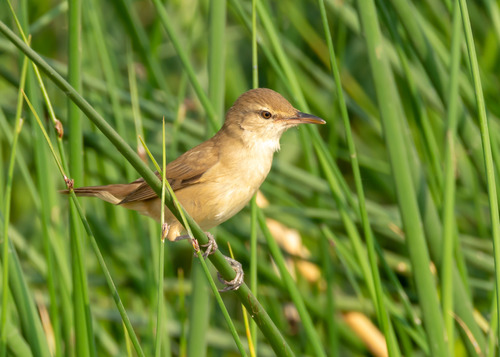
Clamorous Reed Warbler
Acrocephalus stentoreus
A vocal powerhouse of the wetlands, the Clamorous Reed Warbler is more often heard than seen. This master of the marshes thrives in the dense reeds, using its bold personality and rhythmic chatter to defend its territory from Egypt to Southeast Asia.
Quick Identification
Size
Length: 18-20 cm (7.1-7.9 in); Wingspan: 22-25 cm (8.7-9.8 in); Weight: 22-26 g (0.78-0.92 oz)
Colors
Dull olive-brown upperparts, creamy-white to buff underparts, with a pale yellowish wash on the flanks and an indistinct pale eyebrow stripe.
Key Features
- Large, robust bill with a dark upper mandible and paler lower mandible
- Long, rounded tail often flicked or fanned
- Strong, grasping feet suited for clinging to vertical reed stems
- Loud, harsh, chattering song that is persistent and unmusical
When You’ll See Them
Geographic range
Where Does the Clamorous Reed Warbler Live?
The Clamorous Reed Warbler is a widespread resident of the Old World, with a native range extending from the Nile Valley in Egypt through the Middle East and across South Asia to China and Southeast Asia. It is a familiar sight in the wetlands of Pakistan, India, and Sri Lanka, where specific subspecies like A. s. meridionalis have established deep ecological roots. While most populations are resident, some northern groups exhibit partial migration during the winter months.
Basemap © OpenStreetMap contributors
Behavior
The Clamorous Reed Warbler is aptly named for its loud, grating song that can dominate the soundscape of a wetland. While they are bold vocalists, they are surprisingly secretive in their movements, spending much of their time 'skulking' within dense stands of reeds or papyrus. They move with an acrobatic agility, hopping between vertical stems and occasionally hovering for a brief moment to snatch an insect from the air or the surface of the water.
During the breeding season, males become highly territorial and will perch near the tops of reeds to deliver their complex, chattering calls. They are generally solitary or found in pairs, maintaining a strict boundary around their nesting site. Despite their hidden nature, they are curious birds and may momentarily pop into view if they perceive an intruder or a potential food source near the edge of their reed-bed fortress.
EverydayEarth exclusive
Camera Tips
Capturing the Clamorous Reed Warbler on a backyard or trail camera requires strategic placement near their favorite vertical structures. If you have a pond or a water feature with reeds or tall grasses, mount your camera on a stake approximately 2 to 3 feet above the water level. Angle the lens slightly upward to catch them as they climb to the tops of the stalks to sing. Because they are fast-moving, use a high-speed trigger setting or a camera capable of capturing 60fps video to avoid motion blur.
Standard bird feeders rarely attract this species since they are strict insectivores. However, you can lure them toward your lens by maintaining a healthy 'insect-friendly' environment. Avoid pesticides and consider a small solar-powered water dripper; the sound of moving water often draws them out from the deep cover of the reeds to investigate or bathe. Early morning light is your best friend, as the low sun illuminates their brown feathers against the green reeds, providing better contrast for AI detection.
If your camera supports audio recording, this is a major advantage. Their 'clamorous' song is the easiest way to confirm their presence before they even appear on screen. Set your PIR (Passive Infrared) sensitivity to high, as these birds are small and their body heat may be shielded by dense foliage. Placing the camera on the edge of a 'flight path'—a clear gap between two stands of reeds—increases your chances of catching them in the open.
Similar Species
Species that look similar or are commonly confused with Clamorous Reed Warbler.
Frequently Asked Questions
Record Clamorous Reed Warbler at your habitat
Connect a camera to start building your own species record — AI identifies every visitor automatically.