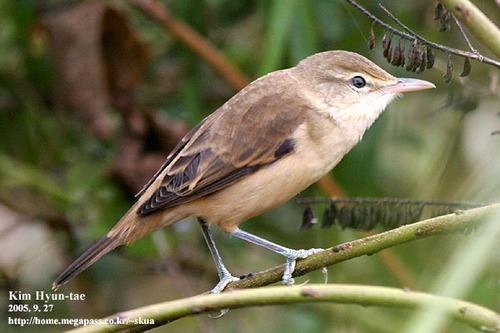
Oriental Reed Warbler
Acrocephalus orientalis
A bold and boisterous songster of the wetlands, the Oriental Reed Warbler is the soundtrack of the East Asian summer. With its striking eyebrow and rhythmic chatter, this migratory marvel is a favorite for backyard birdwatchers near water.
Quick Identification
Size
Length: 18-20 cm (7-8 in); Wingspan: 23-26 cm (9-10 in); Weight: 22-31 g (0.8-1.1 oz)
Colors
Brownish-olive upperparts, creamy-buff underparts, prominent pale supercilium (eyebrow), and dark eye-stripe. The interior of the mouth is a striking reddish-orange.
Key Features
- Prominent pale supercilium above a dark eye-line
- Large, heavy bill for a warbler
- Loud, rhythmic, and 'chattering' song
- Bright reddish-orange interior of the mouth visible when singing
When You’ll See Them
Geographic range
Where Does the Oriental Reed Warbler Live?
This wide-ranging traveler is native to the eastern reaches of the Asian continent. During the breeding months, its core range extends from southeastern Siberia and Mongolia through northern and eastern China, the Korean Peninsula, and across Japan. As a long-distance migrant, it journeys south to spend the winter in the tropical climates of Southeast Asia, the Philippines, Indonesia, and as far south as northern Australia, where it frequents coastal wetlands.
Basemap © OpenStreetMap contributors
Behavior
The Oriental Reed Warbler is a spirited and vocal bird known for its relentless energy. During the breeding season, males are conspicuous as they cling to the tops of reed stems or tall shrubs, pouring out a complex, grating song that can be heard from a significant distance. They are highly territorial during this time, frequently bobbing their tails and flicking their wings when agitated by intruders.
While they are quite bold when singing, they can be elusive when foraging, often creeping through dense vegetation in search of prey. In their wintering grounds in Southeast Asia and Northern Australia, they become more solitary and quiet, though they remain active hunters within reed beds and mangroves. Their relationship with humans is largely one of coexistence; they are common in urban parks and wetlands, provided there is sufficient tall grass or reed cover.
EverydayEarth exclusive
Camera Tips
Capturing the Oriental Reed Warbler on camera requires a bit of strategy since they prefer the thick cover of reeds and tall grasses. To get the best shots, place your AI camera at a height of about 1 to 1.5 metres (3-5 feet), aimed toward the top of sturdy reed stems or prominent 'singing perches' like a fence post or an isolated shrub near a water source. These birds love to survey their territory from the highest available point in their immediate vicinity.
Because they are highly vocal, utilizing a camera with sound-triggering capabilities can be a game-changer; their loud, rhythmic song is often the first sign of their presence. Since they are attracted to water for both foraging and bathing, setting up a camera near a shallow, natural-looking birdbath or a quiet corner of a garden pond can lure them into the open. Ensure your camera is set to a fast shutter speed or high-frame-rate video to capture their quick, jerky movements.
Timing is crucial: during the breeding season (May to August), they are most active and visible in the early morning hours just after sunrise. In garden settings, planting tall ornamental grasses like Miscanthus or Pampas grass can provide the structure they crave. Keep your camera's focus range set for close-to-medium distance, as these birds will often hop quite close to a lens if it is well-camouflaged within the vegetation.
Similar Species
Species that look similar or are commonly confused with Oriental Reed Warbler.
Frequently Asked Questions
Record Oriental Reed Warbler at your habitat
Connect a camera to start building your own species record — AI identifies every visitor automatically.