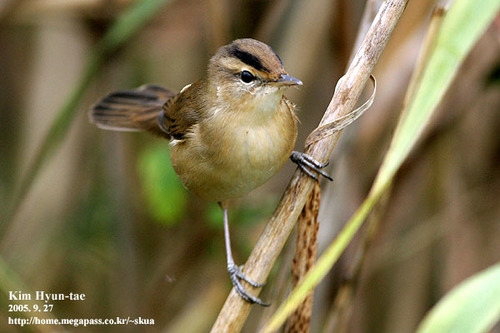
Black-browed Reed Warbler
Acrocephalus bistrigiceps
Recognizable by its bold black 'eyebrows,' this energetic songbird is a master of the marshlands. A long-distance migrant, it brings a lively, chattering song to the reed beds of East Asia every spring.
Quick Identification
Size
Length: 13–14 cm (5.1–5.5 in); Wingspan: 17–19 cm (6.7–7.5 in); Weight: 7–11 g (0.25–0.39 oz)
Colors
Olive-brown upperparts, creamy-white to buff underparts, distinctive pale supercilium bordered by a thick black stripe above.
Key Features
- Prominent black stripe above a pale eyebrow
- Olive-brown back with warmer brown rump
- Pale creamy-buff throat and belly
- Slender, pointed insect-eating bill
- Rounded tail often flicked while foraging
When You’ll See Them
Geographic range
Where Does the Black-browed Reed Warbler Live?
The Black-browed Reed Warbler is native to East and Southeast Asia. Its breeding grounds extend across Northeast China, Japan, the Korean Peninsula, and Eastern Russia. During the winter months, the species migrates south to settle in the tropical wetlands of Thailand, Myanmar, Vietnam, Cambodia, and the Malay Peninsula. This makes it a frequent visitor to both temperate marshes and tropical river deltas throughout the continent.
Basemap © OpenStreetMap contributors
Behavior
The Black-browed Reed Warbler is a secretive and skulking bird, typically found deep within dense wetland vegetation. It is more often heard than seen, possessing a loud, rhythmic song that blends melodic whistles with harsher chattering notes. During the breeding season, males sing from perches within the reeds, though they quickly dive back into cover if they sense movement nearby.
These warblers are highly active foragers, moving with a restless, jerky motion as they glean insects from reed stalks and leaves. While they are generally solitary outside of the breeding season, they can be found in loose groups during migration. They are not particularly bold around humans, but they are remarkably well-adapted to agricultural landscapes like rice paddies and irrigation canals, provided there is sufficient tall grass for shelter.
EverydayEarth exclusive
Camera Tips
Capturing the Black-browed Reed Warbler requires careful placement near water. Position your camera at a low height—roughly 1 to 2 feet above the ground—facing the edge of a reed bed or a dense patch of tall grass. These birds rarely forage high in the canopy, so aiming your lens at the lower half of the vegetation is essential. A side-on angle that captures the transition between water and thick cover is usually the most productive spot.
Because they are attracted to moisture but stay close to cover, a small water feature or a solar-powered dripper placed near thick bushes can lure them into the open. During migration, they are more likely to visit backyard gardens that offer dense, unpruned shrubbery. Avoid placing cameras in wide-open spaces, as these warblers feel vulnerable and will stay hidden. Instead, tuck the camera into the foliage, focusing on a clear 'lane' where the bird might hop across.
Set your camera to its highest trigger speed and use video mode if possible. These birds are extremely twitchy and move with rapid, jerky motions; a photo-only setup often results in blurred images or shots of a disappearing tail. Use a fast shutter speed or high-frame-rate setting to freeze their movement and clearly capture the diagnostic black stripe above the eye. Since they are most active in the low light of dawn, ensure your camera has good low-light sensitivity or a high-quality PIR sensor that can detect small heat signatures through moving reeds.
Similar Species
Species that look similar or are commonly confused with Black-browed Reed Warbler.
Oriental Reed Warbler
Much larger with a heavier bill and lacks the distinct black stripe above the pale eyebrow.
Paddyfield Warbler
Smaller and warmer-toned, with a less prominent and shorter dark stripe above the eyebrow.
Thick-billed Warbler
Lacks any distinct head markings or eyebrow stripes and has a much deeper, hooked bill.
Frequently Asked Questions
Record Black-browed Reed Warbler at your habitat
Connect a camera to start building your own species record — AI identifies every visitor automatically.