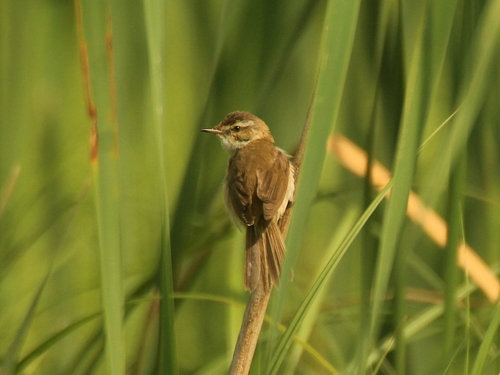
Paddyfield Warbler
Acrocephalus agricola
A tiny, energetic traveler of the reeds, the Paddyfield Warbler is famous for its bold 'eyebrow' and its incredible migratory journey from the steppes of Asia to the marshes of India.
Quick Identification
Size
Length: 12-13.5 cm (4.7-5.3 in); Wingspan: 15-18 cm (6-7 in); Weight: 8-11 g (0.28-0.39 oz)
Colors
Warm sandy-brown upperparts, pale cream underparts, with a distinct whitish eyebrow (supercilium) and a dark-tipped bill.
Key Features
- Bold white supercilium that ends abruptly behind the eye
- Short, stubby bill compared to other Acrocephalus species
- Warm reddish-brown (rufous) rump contrasting with the back
- Pale pinkish-brown legs
When You’ll See Them
Geographic range
Where Does the Paddyfield Warbler Live?
Native to the temperate wetlands of Central Asia and Eastern Europe, the Paddyfield Warbler is a remarkable long-distance migrant. Its breeding grounds stretch from the Black Sea across Kazakhstan to Western China, while the entire population moves south for the winter to settle in the Indian subcontinent and parts of Southeast Asia. You can find them most reliably in countries like India, Pakistan, and Russia during their respective seasons.
Basemap © OpenStreetMap contributors
Behavior
The Paddyfield Warbler is a secretive and restless little bird that spends most of its life weaving through the dense stems of reeds, tall grasses, and agricultural crops. It is highly active, constantly flitting from stem to stem in search of small insects. Unlike some of its louder cousins, it tends to stay lower in the vegetation, making it a rewarding but difficult subject to spot without the help of a motion-activated camera.
During the breeding season, males become slightly more visible as they perch near the tops of reeds to sing their fast, rhythmic song, which often incorporates mimicked sounds from other marsh birds. In their wintering grounds, they are largely solitary and quiet, sticking to 'edge' habitats where water meets thick foliage. They are not particularly bold around humans and will quickly dive into cover if they feel exposed.
EverydayEarth exclusive
Camera Tips
To capture a Paddyfield Warbler on camera, placement is everything. These birds rarely fly high or across open ground, so you should position your camera low—between 1 and 3 feet off the ground—aimed at a small gap in thick reeds or tall grass near a water source. Look for 'natural bridges' where reeds cross over each other, as these are frequent hopping points for the species.
While they won't come to a seed feeder, they are highly attracted to the sound of moving water. Installing a solar-powered dripper or a shallow birdbath nestled within thick cover can lure them into the camera's field of view. Ensure the camera is set to a high-sensitivity motion trigger and a fast shutter speed, as their movements are incredibly fast and nervous, often resulting in motion blur on slower settings.
Lighting in reed beds can be tricky due to harsh shadows. If possible, angle your camera to face north or south to avoid direct sun flare, and try to capture them during the 'golden hours' of early morning when they are most active. Because they are so small, a camera with a close focal range (within 5-8 feet) will provide the best detail for the AI to distinguish the faint facial markings that separate this species from other look-alike warblers.
Similar Species
Species that look similar or are commonly confused with Paddyfield Warbler.
Frequently Asked Questions
Record Paddyfield Warbler at your habitat
Connect a camera to start building your own species record — AI identifies every visitor automatically.