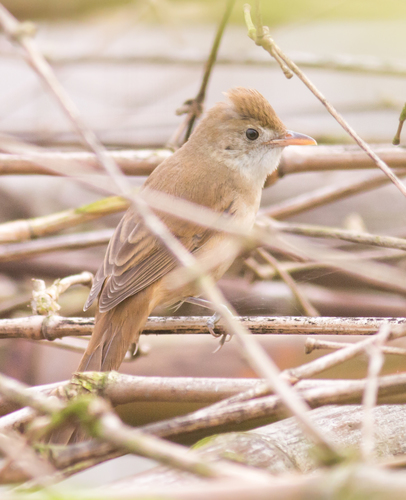
Thick-billed Warbler
Arundinax aedon
A secretive songbird of the East Palearctic, the Thick-billed Warbler is famous for its powerful, melodic voice and its remarkably plain, unstriped face. This master of the thicket is a prized find for backyard observers throughout its long migratory route across Asia.
Quick Identification
Size
16–17.5 cm (6.3–6.9 in) long; wingspan 22–25 cm (8.6–9.8 in); weight 18–28 g
Colors
Uniform warm olive-brown upperparts, creamy-buff underparts, and a whitish throat. No wing bars or distinct facial stripes.
Key Features
- Short, thick bill with a noticeably pale lower mandible
- Absence of a prominent pale eyebrow or supercilium
- Rounded tail that is relatively long
- Large, bulky size compared to other warblers
- Pale legs and a plain, 'open' facial expression
When You’ll See Them
Geographic range
Where Does the Thick-billed Warbler Live?
Native to the eastern Palearctic, the Thick-billed Warbler breeds across a broad northern belt spanning from Southern Siberia through Western Mongolia and into Northern China. As the seasons shift, these birds embark on a long-distance migration to their wintering grounds in the tropical regions of South Asia and Southeast Asia, including India, Thailand, Myanmar, and Vietnam. Though firmly rooted in the Asian continent, they are occasionally spotted as rare vagrants in Western Europe, delighting birdwatchers far outside their typical flight path.
Basemap © OpenStreetMap contributors
Behavior
The Thick-billed Warbler is a notoriously secretive and skulking species that prefers the security of dense vegetation. It spends much of its time moving through thickets, tall grasses, and reed beds, where it can remain almost invisible despite its relatively large size. Unlike many of its relatives, it lacks a strong facial pattern, giving it a distinctive 'plain' look as it hops between branches in search of prey.
While difficult to see, this warbler is highly vocal. Its song is a rich, varied medley of whistles and trills, often incorporating mimicry of other birds. During the breeding season, males sing from deep within cover or occasionally from a semi-exposed perch. In their wintering grounds, they are solitary and territorial, often giving away their presence with a loud, sharp 'chak-chak' alarm call when disturbed.
EverydayEarth exclusive
Camera Tips
Capturing the Thick-billed Warbler on camera requires patience and strategic placement because of its preference for dense cover. Position your camera low, roughly 1 to 3 feet off the ground, and point it toward small clearings within thickets or along the edges of reed beds where the bird might hop across. Because they are fast-moving and shy, use a camera with a high-speed trigger or one that supports pre-roll recording to ensure you don't miss them as they dart through the frame.
In a backyard setting, particularly within their wintering range in South or Southeast Asia, the best way to draw a Thick-billed Warbler into camera range is with a water feature. A shallow birdbath with a solar-powered dripper is irresistible to them. Place the camera about 4-6 feet from the water source, ensuring there is a clear line of sight but plenty of nearby 'escape cover' like bushes or tall grass so the bird feels safe enough to land.
Lighting can be a challenge in the dense habitats these birds prefer. If your camera settings allow, increase the ISO slightly or use a model with excellent low-light performance to capture the subtle brown tones of their plumage. Early morning is the best time for activity, as the birds are most active in their search for insects immediately after sunrise. If your AI camera supports audio triggers, listen for their distinctive 'chak' call, which often precedes an appearance on screen.
Similar Species
Species that look similar or are commonly confused with Thick-billed Warbler.
Frequently Asked Questions
Record Thick-billed Warbler at your habitat
Connect a camera to start building your own species record — AI identifies every visitor automatically.