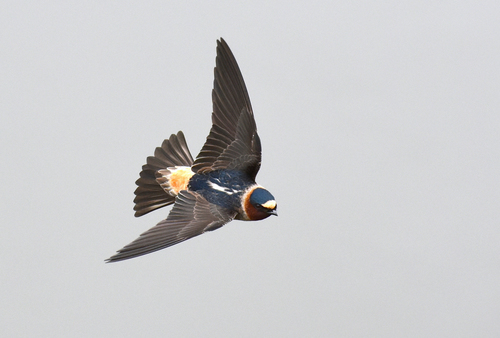
Cliff Swallow
Petrochelidon pyrrhonota
Master architects of the bird world, Cliff Swallows build intricate mud cities under bridges and eaves. Look for their distinct buff rumps and square tails as they perform incredible aerial acrobatics across the summer sky.
Quick Identification
Size
Length: 5.1-5.9 in (13-15 cm); Wingspan: 11.0-11.8 in (28-30 cm); Weight: 0.7-1.1 oz (19-31 g)
Colors
Iridescent blue-black back and crown, rich chestnut-red face and throat, creamy-white forehead patch, and a distinct pale buff or orange rump.
Key Features
- Pale buff-colored rump patch visible in flight
- Square-ended tail, unlike the deeply forked tail of Barn Swallows
- Gourd-shaped mud nests built on vertical surfaces
- White to pale-cream forehead patch
When You’ll See Them
Geographic range
Where Does the Cliff Swallow Live?
Native to the North American continent, the Cliff Swallow maintains a vast breeding range that extends from the subarctic regions of Alaska and Canada down through the United States and into Central Mexico. These birds are long-distance migrants, spending the northern winter months in the southern half of South America, primarily in Argentina, Uruguay, and southern Brazil. They are highly adaptable and have actually expanded their range in recent decades by utilizing man-made structures like bridges and highway culverts for nesting sites.
Basemap © OpenStreetMap contributors
Behavior
These birds are known for their 'information centers'—the colony itself serves as a place where individuals watch their neighbors to see who is returning with a full crop, indicating a successful foraging patch. While they are generally tolerant of human activity, they can be quite vocal around their nests, using a variety of chattering calls to communicate with colony members. Their social complexity extends to their nesting habits, where they occasionally lay eggs in a neighbor's nest, a behavior known as brood parasitism.
EverydayEarth exclusive
Camera Tips
During the spring building season (typically April and May), you can create a 'camera trap' by providing a mud source. In dry areas, swallows struggle to find building materials; a shallow tray of wet clay or a consistently damp patch of soil will attract dozens of swallows. Place your camera on a ground-level tripod or a low mount, focusing on the mud patch. This is one of the few times these birds will land on the ground, offering a rare opportunity for high-detail, close-up photography of their plumage.
For the best lighting, ensure your camera is positioned with the sun behind it, especially during the 'golden hours' of early morning or late afternoon. This lighting will make their iridescent blue backs and buff-colored rumps glow. Because they move incredibly fast, set your camera to the fastest possible shutter speed—ideally 1/1000th of a second or higher—to avoid motion blur. If using a trail camera, ensure the PIR (passive infrared) sensor is on its most sensitive setting, as their small body size and rapid flight can sometimes fail to trigger slower sensors.
Similar Species
Species that look similar or are commonly confused with Cliff Swallow.
Frequently Asked Questions
Record Cliff Swallow at your habitat
Connect a camera to start building your own species record — AI identifies every visitor automatically.