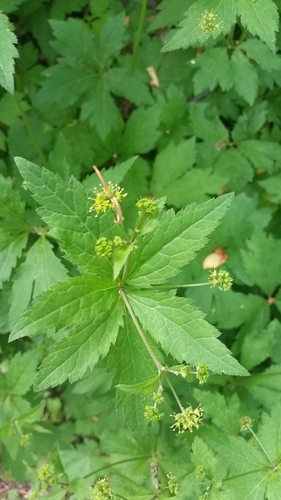
Clustered Sanicle
Sanicula odorata
A vibrant highlight of the shaded forest, Clustered Sanicle features brilliant chartreuse blooms and distinctive star-shaped leaves. This hardy native perennial is a master of survival, using hooked seeds to hitchhike across North American woodlands.
Quick Identification
Size
Stands 30 to 75 cm (1 to 2.5 feet) tall; flower clusters are approximately 1.2 to 2 cm (0.5 to 0.75 inches) wide.
Colors
Bright chartreuse to yellowish-green flowers; deep emerald green leaves; stems are often pale green or occasionally tinged with maroon.
Key Features
- Palmately compound leaves with 5 distinct, sharply toothed lobes
- Round, pom-pom-like flower clusters with long, protruding stamens
- Small, egg-shaped fruits covered in hooked bristles (burs)
- Smooth, upright stems that branch near the top
When You’ll See Them
Geographic range
Where Does the Clustered Sanicle Live?
Clustered Sanicle is native to a broad expanse of eastern North America, thriving in the nutrient-dense soils of the Great Lakes region and the Ohio River Valley. Its range extends from the eastern edges of the Great Plains through the Appalachian Mountains to the Atlantic coast, reaching as far north as Ontario and Quebec and south into the Gulf States. This resilient plant is commonly found in both undisturbed ancient forests and recovering suburban woodlots throughout the United States and Canada.
Basemap © OpenStreetMap contributors
Behavior
Clustered Sanicle is a perennial wildflower that serves as a quiet cornerstone of the forest understory. It emerges in early spring, taking advantage of the sunlight reaching the forest floor before the canopy fully fills in. Unlike many ephemeral wildflowers that vanish by summer, Clustered Sanicle maintains its lush green foliage throughout the growing season, providing consistent ground cover and habitat for small invertebrates.
The plant employs a fascinating strategy for reproduction. Its flowers produce nectar that attracts a variety of small pollinators, particularly sweat bees and flower flies. Once pollinated, it develops bur-like fruits equipped with tiny hooks. These hooks are designed to catch onto the fur of passing mammals or the clothing of hikers—a process known as epizoochory—ensuring its seeds are transported far from the parent plant to colonize new areas of the woods.
EverydayEarth exclusive
Camera Tips
To capture the subtle beauty of Clustered Sanicle with an AI-powered backyard camera, position your device on a low tripod or ground mount. Since this species rarely exceeds two feet in height, a lens height of about 12 inches (30 cm) provides the best perspective for the intricate flower clusters. If your camera has a macro or close-focus mode, use it to highlight the star-like stamens that give the flowers their 'fuzzy' appearance.
Timing is critical for this species. Set your camera to capture high-resolution photos or short video clips during the 'golden hours' of early morning or late afternoon. The low-angle sunlight filtering through the canopy can make the translucent chartreuse flowers glow against the darker forest floor. If you are using a trail camera, look for areas where the plant grows near a game trail; you might capture the exact moment a deer or raccoon brushes against the burs, demonstrating the plant's clever seed dispersal method.
Because Clustered Sanicle remains green all summer, it is an excellent subject for long-term time-lapse projects. Setting your camera to take one photo every few hours from late April through June will allow you to document the transition from the first emerging leaves to the distinctive rounded flower heads and finally the development of the hooked fruits. Ensure the camera is well-camouflaged and the area is clear of fast-growing tall grass that might obscure the view over several weeks.
Similar Species
Species that look similar or are commonly confused with Clustered Sanicle.
Frequently Asked Questions
Record Clustered Sanicle at your habitat
Connect a camera to start building your own species record — AI identifies every visitor automatically.