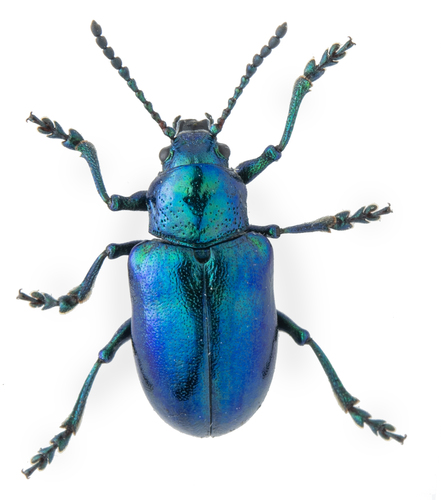
Cobalt Milkweed Beetle
Chrysochus cobaltinus
A shimmering jewel of the western wild, the Cobalt Milkweed Beetle turns ordinary garden plants into a display of iridescent blue. This toxic-but-beautiful leaf beetle is a master of defense and a favorite for backyard macro-photography.
Quick Identification
Size
6–9 mm (0.24–0.35 inches) in length
Colors
Brilliant metallic cobalt blue, occasionally shimmering with teal or deep violet hues; entire body including legs and antennae are iridescent
Key Features
- Intense iridescent cobalt blue or metallic teal coloration
- Oval-shaped, convex body typical of leaf beetles
- Pronounced pitting or punctation on the elytra (wing covers)
- Short, segmented antennae with a metallic sheen
- Commonly found clinging to milkweed or dogbane leaves
When You’ll See Them
Geographic range
Where Does the Cobalt Milkweed Beetle Live?
Native to the North American continent, the Cobalt Milkweed Beetle is a signature species of the Western United States and southwestern Canada. Its geographic footprint is primarily defined by the regions west of the Rocky Mountains, extending from the arid landscapes of the Southwest up through the Pacific Northwest and into British Columbia. While closely related species dominate the east, this brilliant blue beetle is a staple of western grasslands and suburban wildflower patches.
Basemap © OpenStreetMap contributors
Behavior
Cobalt Milkweed Beetles are diurnal insects known for their slow-moving and somewhat bold nature. They spend the majority of their adult lives on host plants, where they feed, mate, and bask in the sun. Their striking metallic color is actually an evolutionary warning signal known as aposematism. By consuming milkweed and dogbane, they sequester toxic cardenolides (cardiac glycosides) within their bodies, making them highly unpalatable and dangerous to birds and other predators.
These beetles exhibit fascinating social behaviors, often found in small clusters on a single plant. During the mating season, males can be quite competitive, and pairs are frequently seen coupled on the undersides of leaves. If a human or predator approaches too closely, they may utilize a defense mechanism called 'thanatosis,' where they tuck their legs and drop off the leaf into the dense undergrowth, disappearing into the shadows to avoid detection.
EverydayEarth exclusive
Camera Tips
Capturing the Cobalt Milkweed Beetle requires a strategic approach to plant selection and camera positioning. Since these beetles are host-specific, your first step is to locate stands of Showy Milkweed (Asclepias speciosa) or Spreading Dogbane. Mount your camera on a flexible tripod or a specialized garden stake, positioning the lens approximately 6 to 12 inches away from the upper leaves where the beetles typically bask in the sun. Because they are small, a camera with a macro lens or high-resolution digital zoom is essential for capturing the fine details of their pitted elytra.
Lighting is the most critical factor when photographing iridescent insects. To truly capture the 'cobalt' glow, aim for mid-morning or late-afternoon sun. Direct overhead noon sun can create harsh 'hot spots' on their metallic shells, blowing out the color. If your camera setup allows for it, side-lighting will emphasize the texture of their wing covers and the brilliant depth of their blue-green shimmer. If you are using an AI-powered trail camera, set the trigger sensitivity to high, as the slight movement of a beetle may not always register as easily as a larger mammal.
Patience is rewarded when observing their behavior. If you set your camera to a time-lapse mode or short video bursts, you are likely to capture their unique 'vein-cutting' feeding strategy or their complex mating rituals. Avoid using chemical lures or baits, as these beetles are strictly attracted to their host plants. Instead, ensure your garden has a healthy, pesticide-free patch of milkweed, and the beetles will naturally congregate there throughout the summer months.
Similar Species
Species that look similar or are commonly confused with Cobalt Milkweed Beetle.
Frequently Asked Questions
Record Cobalt Milkweed Beetle at your habitat
Connect a camera to start building your own species record — AI identifies every visitor automatically.