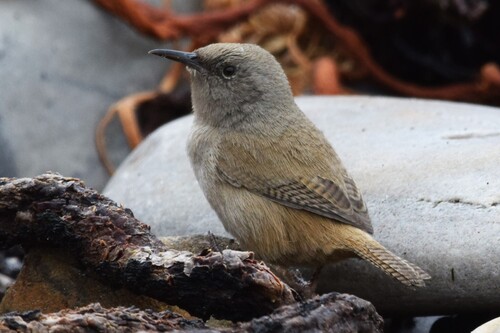
Cobb's Wren
Troglodytes cobbi
The fearless little ghost of the Tussac grass, Cobb's Wren is a rare avian treasure found only on the remote, predator-free islands of the Falklands archipelago.
Quick Identification
Size
12–13.5 cm (4.7–5.3 in) in length; weighs approximately 17–20 grams
Colors
Mousy brown and grey-brown plumage with prominent dark brown barring on the wings and tail; pale buff underparts
Key Features
- Restricted endemic to the Falkland Islands
- Stronger, more elongated bill than other wrens
- Dark, dense barring on flight feathers
- Remarkably tame and inquisitive nature
When You’ll See Them
Geographic range
Where Does the Cobb's Wren Live?
The Cobb's Wren is a high-priority endemic species found exclusively on the Falkland Islands in the South Atlantic. Its natural range has been significantly restricted due to the introduction of invasive predators; today, it is found only on smaller, outlying islands that remain free of rats and cats. It is a true coastal specialist, rarely venturing far from the spray of the ocean and the protective canopy of Tussac grass.
Basemap © OpenStreetMap contributors
Behavior
They are highly territorial and use their surprisingly loud, complex song to defend their patch of coastline. Unlike many small birds that take to the sky when startled, the Cobb's Wren prefers to dive deep into the dense roots of Tussac grass or cracks in coastal rocks to hide from aerial predators like hawks.
EverydayEarth exclusive
Camera Tips
When setting up a camera for the Cobb's Wren, the most important rule is to stay low. These birds are almost entirely terrestrial, spending their days weaving through Tussac grass or hopping over shoreline boulders. Mount your camera no more than 6 to 12 inches off the ground, ideally facing a clear patch of sand or a flat rock where the bird might pause to scan for insects.
Because they are drawn to insects, the best place to position a camera is near 'wrack' lines—the piles of kelp washed up by the tide. This rotting seaweed is a buffet for kelp flies, which in turn draws the wrens out into the open. Using a camera with a wide-angle lens is beneficial here, as the birds are curious and will likely approach the device to investigate its reflection or texture.
To capture their unique social behaviors, look for the 'skirt' of Tussac grass pedestals. These wrens often nest in the dead foliage at the base of these massive grasses. Avoid using heavy baits; instead, ensure your camera has a high-speed trigger and a short recovery time, as their movements are incredibly fast and erratic, making them a challenge for slower trail cams.
Similar Species
Species that look similar or are commonly confused with Cobb's Wren.
Frequently Asked Questions
Record Cobb's Wren at your habitat
Connect a camera to start building your own species record — AI identifies every visitor automatically.