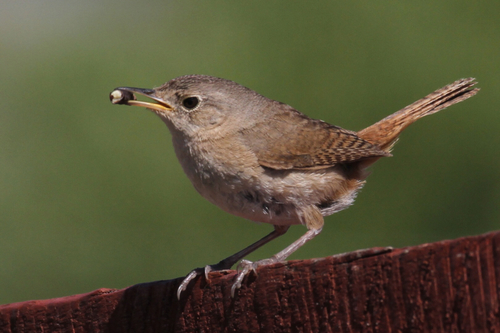
Southern House Wren
Troglodytes musculus
The Southern House Wren is the ultimate backyard neighbor—a tiny, brown powerhouse with a voice that can fill an entire forest. Bold, busy, and endlessly curious, these birds are a delight to watch on any garden camera.
Quick Identification
Size
Length: 11.5–12.5 cm (4.5–5 in); Wingspan: 15 cm (6 in); Weight: 10–14 g (0.35–0.5 oz)
Colors
Uniform warm brown upperparts, pale buffy-grey underparts, with fine dark barring on the wings and tail. Males and females look identical.
Key Features
- Compact, rounded body with a short tail often cocked upward
- Warm brown plumage with subtle dark barring on wings and tail
- Indistinct pale line above the eye
- Loud, complex, bubbling song heard throughout the day
When You’ll See Them
Geographic range
Where Does the Southern House Wren Live?
Native to the Neotropics, the Southern House Wren is one of the most widely distributed birds in the Western Hemisphere. Its range begins in southern Mexico and stretches through every country in Central America into South America, reaching all the way to the southern tip of Tierra del Fuego in Chile and Argentina. These hardy birds have successfully colonized almost every environment within this massive region, from humid tropical lowlands to the temperate valleys of the Andes.
Basemap © OpenStreetMap contributors
Behavior
The Southern House Wren is a tireless dynamo, constantly on the move as it explores every nook and cranny of its territory. Known for its inquisitive nature, this bird often approaches humans with a mix of curiosity and boldness, especially when defending its nesting site. It spends much of its time flitting through low vegetation or hopping along the ground, flicking its wings and tail in a characteristic restless fashion.
These birds are highly territorial and famous for their vocalizations. The male delivers a rich, cascading series of whistles and trills to claim his domain. Unlike many tropical birds, they are remarkably adaptable to human presence, frequently choosing to nest in man-made structures like flower pots, rafters, or specialized birdhouses, making them a favorite for backyard birdwatchers.
EverydayEarth exclusive
Camera Tips
To capture the Southern House Wren, focus your camera on potential nesting sites. These birds are cavity nesters and are highly attracted to wooden birdhouses with a 1-inch (2.5 cm) entrance hole. Mount your camera 5–6 feet (1.5–2 meters) off the ground, angled toward the nest entrance or a nearby 'staging' perch where the bird will land before entering. Because they are incredibly fast, set your camera to a high-speed trigger mode or 'Burst' to catch them in flight.
Wrens are also frequent visitors to shallow bird baths. Positioning a camera near a water feature with a textured bottom will reward you with excellent footage of their vigorous bathing rituals. They prefer water that is near cover, so place the bath within a few feet of shrubs or bushes where they can retreat if they feel threatened. Use a fast shutter speed or high frame rate (60fps+) to capture the water droplets and rapid wing movements.
If you aren't using a nest box, look for 'micro-habitats' like woodpiles, dense ivy, or garden sheds. These birds are nicknamed 'hole dwellers' for a reason; they spend hours poking their heads into small gaps looking for spiders. A camera placed low to the ground (12–18 inches) facing a brush pile or the base of a thick hedge is a great way to capture their natural foraging behavior. Morning light is best, as they are most active and vocal just after sunrise.
Similar Species
Species that look similar or are commonly confused with Southern House Wren.
Frequently Asked Questions
Record Southern House Wren at your habitat
Connect a camera to start building your own species record — AI identifies every visitor automatically.