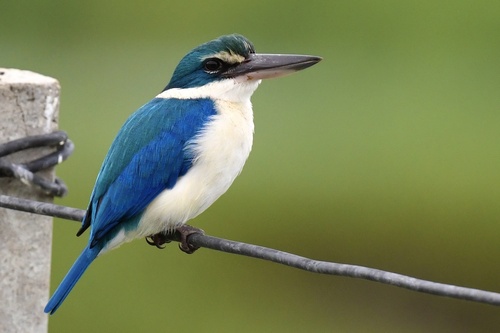
Collared Kingfisher
Todiramphus chloris
With its brilliant turquoise plumage and iconic 'bandit' mask, the Collared Kingfisher is one of the most striking and vocal birds you can discover in your backyard. A master of the sit-and-wait hunt, it brings a flash of tropical color to gardens across the Indo-Pacific.
Quick Identification
Size
23–25 cm (9–10 in) long; wingspan approx. 35–42 cm (14–16 in); weight 50–100g
Colors
Brilliant turquoise-blue upperparts, snowy white underparts, and a distinct white collar. Features a broad black mask extending from the bill through the eyes to the nape.
Key Features
- Distinctive white collar around the neck
- Broad black 'bandit' mask across the eyes
- Large, heavy black bill with a pale base on the lower mandible
- Turquoise-blue wings and tail with white underparts
When You’ll See Them
Geographic range
Where Does the Collared Kingfisher Live?
Native to a massive expanse across the Indo-Pacific, the Collared Kingfisher's range begins at the Red Sea and the coast of East Africa, stretching across Southern Asia and the Indonesian archipelago to Australia and the Pacific Islands. It is a dominant presence in coastal and lowland regions of countries like India, Singapore, Thailand, and the Philippines. While primarily a bird of the tropics and subtropics, its ability to thrive in man-made landscapes has allowed it to maintain high population densities across its vast geographical footprint.
Basemap © OpenStreetMap contributors
Behavior
The Collared Kingfisher is a bold and conspicuous bird, often heard before it is seen. It is highly territorial and known for its loud, piercing 'chew-chew-chew' call, which it uses to defend its patch from intruders. Unlike some of its shy forest-dwelling cousins, this species has adapted remarkably well to human environments, frequently perching on telephone wires, fences, and rooftops to scan for prey.
As a 'sit-and-wait' predator, it remains remarkably still for long periods on an exposed perch before suddenly diving to the ground or water to snatch a meal. While they are solitary hunters, they form monogamous pairs during the breeding season, often excavating nests in rotting tree trunks, termite mounds, or even earth banks. They are generally resident birds, staying in the same territory year-round if food sources remain stable.
EverydayEarth exclusive
Camera Tips
To capture the Collared Kingfisher on a backyard camera, look for 'scout perches.' These birds love high, unobstructed vantage points like the top of a fence post, a bare tree limb, or a clothesline. Position your camera 2-3 meters high, angled slightly downward toward a known perch. Because they are sit-and-wait hunters, they will often return to the same branch multiple times a day, making it the perfect spot for a trigger-activated photo.
While they don't eat seeds, you can lure them toward your camera by providing a water feature. A shallow birdbath or a small garden pond with a solar-powered fountain is irresistible to them. The movement and sound of splashing water often trigger their hunting or bathing instincts. Place the camera near the edge of the water to catch them mid-splash or while they are drying their feathers afterward.
Because kingfishers move with incredible speed when they dive, camera settings are crucial. Use a fast trigger speed (less than 0.5 seconds) and, if possible, a 'burst mode' or high-frame-rate video setting. Their turquoise feathers are highly reflective, so try to position your camera with the sun at its back to avoid washing out the brilliant blues in the morning light. Avoid placing the camera where it faces the direct midday sun, as the white breast of the bird can easily overexpose.
Similar Species
Species that look similar or are commonly confused with Collared Kingfisher.
Frequently Asked Questions
Record Collared Kingfisher at your habitat
Connect a camera to start building your own species record — AI identifies every visitor automatically.