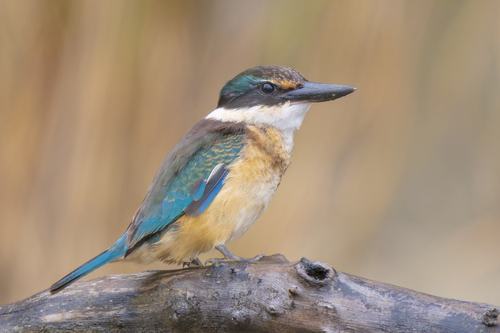
Sacred Kingfisher
Todiramphus sanctus
A flash of turquoise in the Australian bush, the Sacred Kingfisher is a master of the 'sit-and-wait' hunt. From mangroves to suburban backyards, this iconic bird brings a splash of tropical color to the woodland canopy.
Quick Identification
Size
Length: 19–23 cm (7.5–9 in); Wingspan: 29–35 cm (11.5–13.8 in); Weight: 28–65 g (1–2.3 oz)
Colors
Upperparts are a striking turquoise-blue or sea-green. Underparts and collar are creamy-white to buff. Features a broad black mask extending from the bill through the eyes to the ear coverts.
Key Features
- Vibrant turquoise-green back and wings
- Broad black 'bandit' mask through the eyes
- Creamy-buff underparts and neck collar
- Robust, dagger-like black bill
When You’ll See Them
Geographic range
Where Does the Sacred Kingfisher Live?
The Sacred Kingfisher is native to the vast landscapes of Oceania and the Western Pacific. Its primary strongholds are Australia and New Zealand, where it is a beloved sight in both the bush and the suburbs. While many populations remain resident year-round, southern birds are known to migrate north during the winter, reaching as far as New Guinea, the Solomon Islands, and parts of eastern Indonesia. They are also widely distributed across New Caledonia and several smaller Pacific island chains.
Basemap © OpenStreetMap contributors
Behavior
The Sacred Kingfisher is a solitary hunter known for its remarkable patience and precision. Unlike many of its aquatic relatives, this species is a 'land kingfisher' that spends much of its time perched motionlessly on high vantage points such as dead branches, power lines, or fence posts. From these sentinels, it scans the ground for movement, launching into a swift, controlled dive to snatch prey before returning to its perch to consume the meal.
During the breeding season, these birds become much more conspicuous and vocal, defending their territories with a persistent, high-pitched 'kek-kek-kek-kek' call. They are also known for their unique nesting habits, often excavating tunnels in arboreal termite mounds, rotting tree hollows, or soft earthen banks. While they can be shy, they are increasingly common in urban environments where they have learned to utilize backyard fences as hunting platforms.
EverydayEarth exclusive
Camera Tips
Capturing a Sacred Kingfisher on camera requires focusing on their 'sentinel' behavior. These birds are creatures of habit and will often return to the exact same perch multiple times a day to hunt. Look for exposed, dead branches or the top of a fence post overlooking an open patch of grass. Position your camera at a height of 1.5 to 2.5 meters (5-8 feet), aiming slightly upward if the perch is elevated. Because they dive suddenly, use a camera with a fast trigger speed or set your AI camera to a high-sensitivity motion zone around their favorite branch.
Water is a powerful lure for this species, even if they aren't fishing. They are frequent visitors to backyard birdbaths for 'plunge-bathing,' where they dive into the water and quickly return to a nearby branch to preen. Setting your camera near a clean water source with a clear, unobstructed flight path will often result in the best action shots. Ensure the camera is positioned to catch the sunlight from behind you, as their turquoise feathers are structural and look most brilliant when directly illuminated.
Seasonal timing is key for backyard enthusiasts. In southern Australia and New Zealand, focus your efforts between September and March when the birds are breeding and most active. If you have a large property, listen for their distinctive calling; they often nest in arboreal termite mounds (the 'mud nests' in trees). Placing a camera at a respectful distance from a known nesting site can provide incredible footage of the adults bringing insects to their chicks, but be careful not to disturb them during this sensitive time.
Similar Species
Species that look similar or are commonly confused with Sacred Kingfisher.
Forest Kingfisher
Has a much whiter underbelly and a larger, distinct white spot in front of the eye compared to the Sacred's buff tones.
Collared Kingfisher
Larger and chunkier with a much heavier bill; its collar and underparts are bright white rather than buff.
Laughing Kookaburra
Significantly larger and lacks the brilliant turquoise-blue back, featuring brown and cream plumage instead.
Frequently Asked Questions
Record Sacred Kingfisher at your habitat
Connect a camera to start building your own species record — AI identifies every visitor automatically.