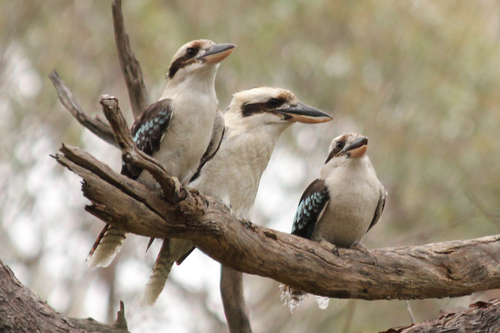
Laughing Kookaburra
Dacelo novaeguineae
Famous for its iconic 'laughing' call and bold personality, the Laughing Kookaburra is the king of the Australian backyard. This giant kingfisher is a social, territorial marvel that brings the sound of the wild right to your porch.
Quick Identification
Size
39–45 cm (15–18 in) long; wingspan ~65 cm (26 in); weight 300–500 g (10–18 oz)
Colors
Creamy-white head with a dark brown eye-stripe; dark brown upperparts; sky-blue patches on wings; rufous and black barred tail
Key Features
- Massive, boat-shaped bill with a dark upper mandible
- Bold dark brown stripe running through the eye
- Loud, rhythmic vocalization sounding like human laughter
- Stocky build with a relatively large head
When You’ll See Them
Geographic range
Where Does the Laughing Kookaburra Live?
Native to the eastern and southeastern portions of the Australian continent, the Laughing Kookaburra is a common sight from the Cape York Peninsula down to the southern coast of Victoria. It has also been successfully introduced to Western Australia, Tasmania, and parts of New Zealand's North Island, where it has adapted well to local environments. These birds are highly resident, typically staying within the same territory throughout their lives provided there are sufficient nesting hollows and prey.
Basemap © OpenStreetMap contributors
Behavior
The Laughing Kookaburra is a highly social bird, living in stable family groups consisting of a breeding pair and several non-breeding offspring. These "helpers" assist in defending the territory and raising subsequent broods. They are famous for their raucous, laughing chorus, which is actually a territorial warning used to signal the boundaries of their home range to neighboring groups, most frequently heard at dawn and dusk.
As "sit-and-wait" predators, they spend long periods perched motionlessly on branches or power lines, scanning the ground for movement. When prey is spotted, they dive down with precision to snatch it. While they are a beloved icon of the Australian bush, they can be remarkably bold in suburban settings, often swooping down to investigate backyard activities or even stealing food directly from outdoor tables.
EverydayEarth exclusive
Camera Tips
To capture the best footage of a Laughing Kookaburra, mount your AI-powered camera on a vertical post or tree trunk at a height of roughly 5 to 7 feet. These birds are habitual perchers; look for a low-hanging, sturdy branch that overlooks an open patch of lawn or a garden bed. If you notice a kookaburra frequently returning to the same branch to scan for worms or lizards, that is your prime location for a camera setup.
Water is a major draw for this species. Unlike many smaller birds that prefer shallow dishes, kookaburras appreciate larger, sturdier bird baths where they can plunge in for a vigorous bath. Positioning your camera with a clear view of a water feature will likely yield excellent action shots, especially during the warmer midday hours when they seek to cool down.
Because the Laughing Kookaburra is most active and vocal during the "golden hours" of dawn and dusk, check that your camera settings are optimized for low-light performance. Use a fast trigger speed or high-frame-rate video setting, as their strike from a perch is incredibly rapid. If your camera supports it, a "burst" mode is ideal for capturing the moment they bash a lizard or large insect against a branch—a classic kookaburra behavior used to soften food before swallowing.
Similar Species
Species that look similar or are commonly confused with Laughing Kookaburra.
Frequently Asked Questions
Record Laughing Kookaburra at your habitat
Connect a camera to start building your own species record — AI identifies every visitor automatically.