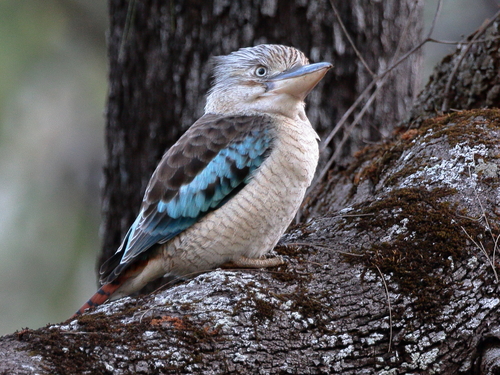
Blue-winged Kookaburra
Dacelo leachii
The Blue-winged Kookaburra is the striking, sapphire-winged icon of Australia's tropical north. Known for its piercing bark and masterful hunting skills, this social kingfisher brings a splash of brilliant color to backyards and woodlands alike.
Quick Identification
Size
Length: 38-42 cm (15-16.5 inches); Wingspan: 55-65 cm (21.5-25.5 inches); Weight: 250-370g (8.8-13 oz)
Colors
Pale, streaked off-white head; vibrant sky-blue patches on wings and rump; creamy underparts. Males have all-blue tails, while females have reddish-brown barred tails.
Key Features
- Large, heavy bill with a dark upper and pale lower mandible
- Distinctive pale, almost white eyes
- Vibrant blue wing coverts and rump
- Broad, square-headed profile with fine brown streaks on the crown
When You’ll See Them
Geographic range
Where Does the Blue-winged Kookaburra Live?
This tropical kingfisher is native to the northern regions of the Australian continent and parts of southern New Guinea. Its core range extends across the 'Top End,' reaching from the Shark Bay area in Western Australia, through the Kimberley and Northern Territory, and sweeping down the Queensland coast as far south as Brisbane. While it is a permanent resident throughout its range, it is most densely populated in the humid, wooded savannas of the north.
Basemap © OpenStreetMap contributors
Behavior
The Blue-winged Kookaburra is a highly social bird, typically living in family groups of up to a dozen individuals. These groups often consist of a primary breeding pair and several 'helpers'—offspring from previous years that assist in defending the territory and raising new chicks. Unlike the more famous Laughing Kookaburra, this species does not 'laugh'; instead, it emits a loud, abrasive cackle or a series of barking notes that can sound quite frantic and discordant, especially when the whole family joins in at dawn.
These birds are masterful sit-and-wait predators. They spend long periods perched motionlessly on high branches or power lines, using their keen eyesight to scan the ground for movement. When they spot prey, they launch into a steep dive, seizing the target with their massive bills and returning to the branch to dispatch it, often by striking it repeatedly against the wood. While generally wary of humans in the wild, they can become quite bold in suburban settings, occasionally visiting backyards for water or to hunt insects stirred up by gardening.
EverydayEarth exclusive
Camera Tips
To capture high-quality footage of the Blue-winged Kookaburra, focus on their hunting patterns. These birds prefer prominent, exposed perches like horizontal branches, fence posts, or clotheslines that give them a clear view of the ground. Mount your camera 2 to 4 metres high on a nearby structure, angled slightly downward toward an open patch of lawn or mulch where they are likely to swoop for insects. Ensure the area is clear of swaying tall grass, which can trigger the sensor unnecessarily in the tropical breeze.
Water is the single best lure for this species, especially during the dry season (May to October). A large, sturdy birdbath or a shallow pond will attract them not just for drinking, but for spectacular bathing displays. Place your camera about 2-3 metres from the water source to capture the full wing extension and the brilliant blue plumage. Since their movements are lightning-fast during a dive, use a high-speed trigger setting or a video mode with at least 60fps to avoid motion blur.
For the best lighting, aim for the golden hours of the morning. The low-angle sunlight will catch the iridescent blue feathers on their wings and rump, which can look dull or black in flat, midday light. If you are placing a camera in a wooded area, look for 'pellets' (regurgitated bundles of insect wings and bones) on the ground; these indicate a frequently used roosting branch directly above, which is a prime spot for a long-term camera setup.
Similar Species
Species that look similar or are commonly confused with Blue-winged Kookaburra.
Frequently Asked Questions
Record Blue-winged Kookaburra at your habitat
Connect a camera to start building your own species record — AI identifies every visitor automatically.