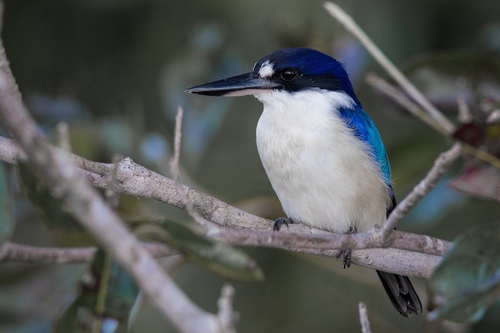
Forest Kingfisher
Todiramphus macleayii
With its electrifying turquoise plumage and bold personality, the Forest Kingfisher is a crown jewel of the coastal bush. Discover how this master hunter turns your backyard into its personal safari ground.
Quick Identification
Size
Length: 19–23 cm (7.5–9 in); Wingspan: ~30 cm (12 in); Weight: 32–43 g (1.1–1.5 oz)
Colors
Brilliant turquoise-blue upperparts and head, stark white underparts. Males have a complete white collar; females have a blue patch at the nape (broken collar).
Key Features
- Vibrant turquoise-blue back and wings
- Large white spot between the bill and eyes
- Long, heavy black bill with a pale lower mandible
- Wide white wing patches visible during flight
When You’ll See Them
Geographic range
Where Does the Forest Kingfisher Live?
Native to the Oceania region, the Forest Kingfisher is primarily found along the northern and eastern coastal fringes of Australia. Its range extends from the Kimberley region across the Top End and down the east coast into New South Wales, while also inhabiting the tropical lowlands of New Guinea and parts of eastern Indonesia. In the southern parts of its Australian range, it is a seasonal visitor, migrating north for the winter months.
Basemap © OpenStreetMap contributors
Behavior
The Forest Kingfisher is a patient, sit-and-wait predator. Unlike many of its cousins that dive for fish, this species is a "tree kingfisher" that spends its day perched on high vantage points like telephone wires, bare branches, or fence posts. From these lookouts, it scans the ground for movement, launching into a swift, direct dive to snatch up insects or small reptiles before returning to its perch.
Socially, they are often seen in pairs and are fiercely territorial during the breeding season. One of their most fascinating behaviors is their nesting habit: they use their strong bills to tunnel into active arboreal (tree-dwelling) termite mounds. They are bold birds and relatively tolerant of human presence, often becoming a familiar fixture in coastal gardens where open lawns provide easy hunting grounds.
EverydayEarth exclusive
Camera Tips
To capture the stunning blue of a Forest Kingfisher, you must identify their favorite 'hunting perches.' These birds are creatures of habit and will return to the same bare branch, clothesline, or fence post day after day. Position your camera 5 to 10 feet away from these perches, ideally at eye level with the bird. Because they dive suddenly, a camera with a fast trigger speed or a pre-buffer recording feature is essential to catch the moment they take flight.
While you won't find them at a seed feeder, you can encourage them to visit your camera's field of view by providing a consistent water source. A raised birdbath in an open area of the yard is a magnet for them. They use water not just for drinking but for 'plunge-bathing,' where they dive into the water and return to a branch to preen. Set your camera to a high frame rate (60fps or higher) to capture the water droplets spraying off their iridescent feathers.
Lighting is your best friend with this species. Their blue feathers are structural, meaning they look most vibrant in direct sunlight. Try to orient your camera facing south (in the Southern Hemisphere) so the morning sun illuminates the bird from the front. If using a trail camera, look for 'burst mode' settings to ensure that at least one frame captures the bird with its wings spread, revealing the brilliant white 'mirrors' or wing patches that are hidden when perched.
Similar Species
Species that look similar or are commonly confused with Forest Kingfisher.
Frequently Asked Questions
Record Forest Kingfisher at your habitat
Connect a camera to start building your own species record — AI identifies every visitor automatically.