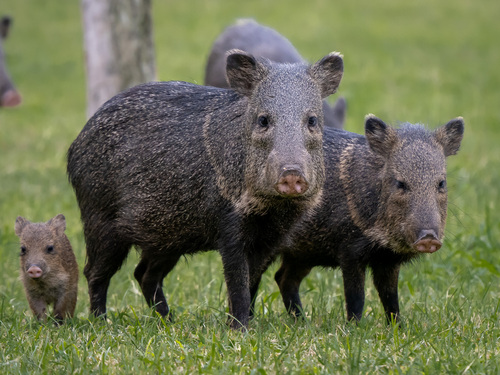
Collared Peccary
Pecari tajacu
Meet the desert's most social survivor. Often confused with wild pigs, the Collared Peccary is a fascinating, 'squad-oriented' mammal that thrives from the Arizona desert to the Amazon rainforest.
Quick Identification
Size
Length: 80–105 cm (31–41 in); Height: 30–50 cm (12–20 in); Weight: 15–30 kg (33–66 lbs)
Colors
Coarse salt-and-pepper gray or black fur; a distinctive yellowish-white 'collar' of hair runs from the throat over the shoulders.
Key Features
- Pig-like snout with a heavy, stocky body
- Distinct light-colored collar across the shoulders
- Straight, sharp tusks that point downward
- Small, rounded ears and a nearly invisible tail
When You’ll See Them
Sightings on EverydayEarth
Jun 5, 2026
A Collared Peccary walks across the lower left quadrant of the viewing area, passing near the base of a wooden feeder stand. Its distinctive grizzled coat and pale neck collar are clearly visible against the rocky ground.
May 21, 2026
A group of Collared Peccaries, also known as javelinas, are foraging across the gravel ground at night. They move purposefully through the scene, sniffing the earth and leaf litter for fallen seeds and vegetation near the bushes and the base of the bird feeder.
May 12, 2026
A Collared Peccary, or javelina, is seen walking across the background behind the feeder area during the night.
May 5, 2026
A group of at least four javelinas (collared peccaries) is seen foraging at night. One individual moves steadily across the foreground from right to left, while the others remain clustered near the base of the bird feeder, sniffing the ground for spilled seeds.
May 1, 2026
A small group of Collared Peccaries is seen foraging on the ground beneath the bird feeder. They move across the dry, leaf-littered soil, sniffing for food as dawn begins to break.
Apr 13, 2026
A Collared Peccary, also known as a javelina, is foraging on the ground in the lower right of the frame. It moves its head around while sniffing the rocky soil, likely looking for fallen seeds or roots near the base of the bushes.
Geographic range
Where Does the Collared Peccary Live?
The collared peccary is a resilient New World mammal native to a massive range across the Americas. It is found as far north as the southwestern United States—specifically Arizona, New Mexico, and Texas—and extends southward through Mexico and Central America. In South America, they inhabit almost the entire continent east of the Andes, reaching as far south as northern Argentina. They are particularly successful in the Chihuahuan and Sonoran deserts but are equally at home in the Amazon basin.
Basemap © OpenStreetMap contributors
Behavior
Collared peccaries, or javelinas, are exceptionally social mammals that live in tight-knit groups called 'squads.' These squads usually consist of 6 to 30 individuals that forage, sleep, and defend their territory together. They rely heavily on their sense of smell, using a specialized scent gland on their lower back to mark rocks, trees, and even each other. This 'musky' odor is so strong that humans can often smell a squad before seeing them, earning them the nickname 'musk hogs.'
Despite their somewhat fierce appearance, javelinas are generally shy and prefer to avoid conflict with humans. However, they are highly defensive of their young and can be aggressive toward dogs, which they perceive as predatory coyotes. They communicate through a complex vocabulary of barks, grunts, and a characteristic tooth-clattering sound that serves as a warning to potential threats.
EverydayEarth exclusive
Camera Tips
To capture high-quality images of collared peccaries, camera placement is everything. Since they are relatively short, mount your camera low to the ground—about 12 to 18 inches high. This 'javelina-eye view' captures the detail of their snouts and the distinctive white collar. If you place the camera too high, you’ll mostly get shots of their backs. Because they travel in squads, use a wide-angle setting or position the camera at least 10 feet away from a trail to ensure you see the whole group rather than just one individual.
In arid environments, water is the ultimate lure. A backyard pond, a dripping irrigation line, or even a shallow dish of water will act as a magnet for local squads. They are also highly attracted to salt licks or mineral blocks. If you are tracking them in a more wild setting, look for 'javelina tunnels' through dense brush or muddy wallows where they cool off; these are the best spots to intercept them during their daily rounds.
Timing your monitoring is key to success. In the summer, javelinas are almost exclusively crepuscular or nocturnal to avoid the desert heat, so ensure your camera has a strong infrared flash and fast trigger speed for night captures. In the winter, they are more likely to be active during the day, often basking in the morning sun to regulate their temperature. Check for scent-marking posts—usually a specific rock or tree trunk with visible rub marks—as these are high-traffic areas they visit repeatedly.
Similar Species
Species that look similar or are commonly confused with Collared Peccary.
Frequently Asked Questions
Record Collared Peccary at your habitat
Connect a camera to start building your own species record — AI identifies every visitor automatically.