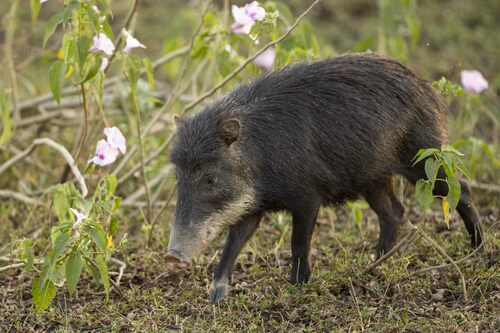
White-lipped Peccary
Tayassu pecari
The White-lipped Peccary is the ultimate social wanderer of the Neotropics, traveling in thunderous herds that reshape the forest floor. Distinguished by their stark white facial markings and fierce group loyalty, they are one of the most charismatic—and loudest—mammals of the rainforest.
Quick Identification
Size
Head and body length of 90–139 cm (35–55 in); shoulder height of 40–60 cm (16–24 in); weight range of 25–40 kg (55–88 lbs).
Colors
Uniformly dark brown to black coarse hair; distinctive white or cream-colored patch covering the lower jaw, chin, and throat.
Key Features
- Prominent white patch on the lower jaw and throat
- Coarse, dark, bristle-like fur
- Highly social, traveling in herds of 50 to 300+ individuals
- Large, triangular head with a robust snout
When You’ll See Them
Geographic range
Where Does the White-lipped Peccary Live?
Native to the Neotropical realm, the White-lipped Peccary occupies a broad geographic range starting in southern Mexico and extending through Central America into the South American continent. They are most prevalent throughout the Amazon Basin and the Gran Chaco, reaching as far south as northern Argentina. While they once occupied a continuous range, their populations are now increasingly fragmented, especially in the northernmost and southernmost reaches of their territory.
Basemap © OpenStreetMap contributors
Behavior
White-lipped Peccaries are perhaps the most social of all ungulates in the Americas. They roam through vast territories in massive herds that can number in the hundreds, functioning as a single, coordinated unit. This social structure provides protection against top predators like jaguars and pumas; when threatened, the herd will collectively face the danger, clattering their tusks to create a terrifying rhythmic clicking sound that warns off intruders.
They are known as the "engineers of the forest" because their constant foraging and trampling significantly alter the landscape. They have a strong, musky odor produced by a scent gland on their back, which they use to mark one another and maintain herd cohesion. To a human observer, a nearby herd is often smelled or heard—through the sound of snapping branches and chattering teeth—long before it is seen.
EverydayEarth exclusive
Camera Tips
Capturing White-lipped Peccaries on camera requires a strategy that accounts for their massive group sizes. Because they travel in large herds, avoid placing your camera in narrow bottlenecks where a single animal might stop and block the lens for the entire group. Instead, aim for wide-angle views along clear forest trails or near known fruiting trees like palms. Set your camera to take 3-photo bursts or 15-30 second videos; a single photo rarely captures the true scale of a herd that can take five minutes to pass by.
Mount your camera lower than you would for deer, ideally at about 18 to 24 inches (knee height). This lower angle is perfect for capturing the distinctive white jaw markings and the lower-set eyes. Be warned that these animals are highly curious and have a powerful sense of smell. They may investigate, lick, or even rub their scent glands on a camera that smells like humans. Use a high-quality security box and try to mask your scent during installation.
Water sources and mud wallows are gold mines for White-lipped Peccary footage. These social animals love to bathe together to cool off and socialise. If you are in a drier forest type, a camera pointed at a persistent water hole is almost guaranteed to capture them. Because they are nomadic and range over huge areas, don't be discouraged if you don't see them for weeks; when they do arrive, they will provide hundreds of triggers in a single visit.
Similar Species
Species that look similar or are commonly confused with White-lipped Peccary.
Collared Peccary
Smaller in size with a visible light-colored 'collar' around the neck and much smaller social groups.
Chacoan Peccary
Has longer ears, a longer tail, and is found exclusively in the dry shrublands of the Gran Chaco.
Wild Boar
A true pig (Suidae) with longer, curved tusks and a different social structure; lacks the white jaw patch.
Frequently Asked Questions
Record White-lipped Peccary at your habitat
Connect a camera to start building your own species record — AI identifies every visitor automatically.